
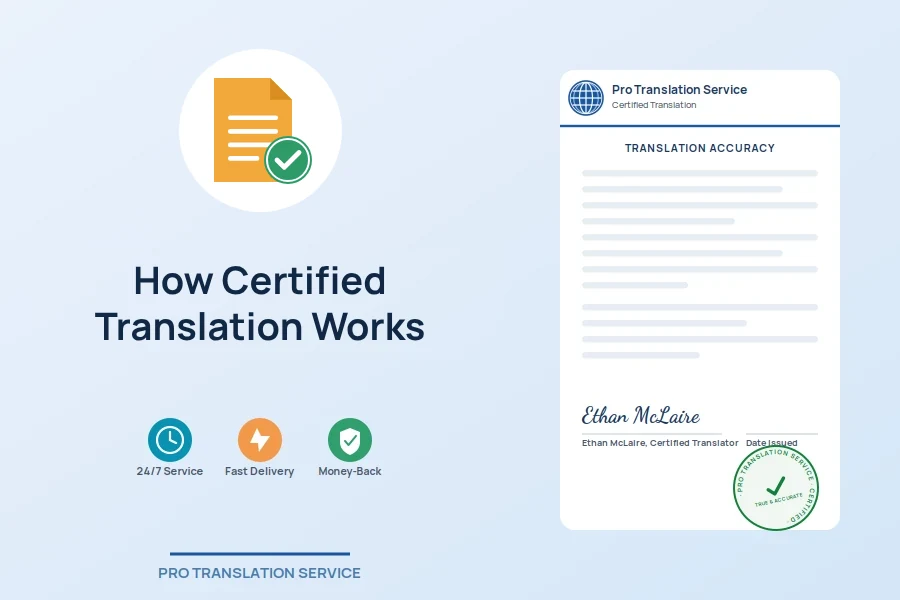
Quick answer: To order a certified document translation, upload a clear scan of every page, choose standard or rush delivery, approve the quote, and receive a signed PDF with the English translation and a Certificate of Accuracy. At Pro Translation Service it costs $22.99 per page, with delivery within 24 hours for documents up to 3 pages.
This guide walks you through ordering a certified document translation, step by step: what to prepare, what happens after you upload, what you receive, what it costs and how long it takes. A translation that is not done and certified correctly can be rejected by USCIS, a court or a university, which costs time and money. If you first want to know what a certified translation is, start with our beginner’s guide to certified translation.
Related guides in this series:
How to Order, Step by Step
Certified document translation follows a set process designed for accuracy and for acceptance by official authorities such as USCIS and courts.
Submitting your documents: most services let you upload scanned copies of your originals through a secure online portal. Clear, high-resolution scans of both sides of each page speed up the process far more than a single blurry photo.
Translation by a qualified professional: a human translator fluent in both languages and familiar with the document type does the work. No machine translation is used at any stage. For the reasoning, see our guide on why professional translation beats AI tools. The translator converts every word, number, stamp, and layout detail while preserving the original meaning and format.
Editing and quality assurance: a second experienced linguist reviews the translation for accuracy, consistency, and completeness. This step catches issues before certification, not after submission.
Certification and final formatting: the translator or agency representative adds the signed certification statement. The final file is formatted to match the original layout as closely as possible and delivered in PDF or whatever format you need.
Delivery: you receive the certified translation by email or download within the delivery time you were quoted, ready to submit to USCIS, a court, or another institution. The receiving authority decides whether to accept it.
What Certified Document Translation Covers
Certified document translation services provide professional, accurate translations of official documents for legal, immigration, academic, and business use. Unlike regular translations, these services guarantee that the English version fully matches the original and includes proof of accuracy that a receiving authority can rely on. Professional agencies use human translators only for this work. Machine translation is not part of a certified process at any stage.
These services matter when a government office, court, school, or business requires proof that the translation is reliable, and fluent wording alone is not enough. The final product includes the translated text plus a signed certification confirming completeness and correctness. That certification satisfies the receiving authority’s requirement.
What You Receive
Your order comes back as a PDF with the complete English translation and a signed certification statement. In it, the translator confirms that the translation is complete and accurate and that they are competent in both languages, and gives their name, signature, contact details and the date. USCIS asks for this under 8 CFR 103.2(b)(3). See what information a certificate of accuracy includes for a sample wording and a checklist, or our beginner’s guide to what a certified translation is for the full definition.
Certified Translation vs. Standard Translation
A standard translation converts text from one language to another and carries no formal proof of accuracy. A certified translation adds the signed certification statement and is built for official use. Authorities often reject standard translations because they lack that proof, not because the wording is wrong. Our guide to the key differences between certified and standard translation explains which one you need.
When Is Certified Document Translation Required?
Submitting an uncertified or incorrect translation can lead to a rejection, delays, or a request for additional evidence, however good the underlying translation is.
Immigration and USCIS Requirements
USCIS requires every non-English document to be submitted with a complete English translation and a signed certification of accuracy and translator competence. A missing or incomplete translation can lead to a Request for Evidence (RFE) or a denial, at the officer’s discretion. See our full list of immigration authorities we translate for if your destination is not USCIS.
Legal and Court-Related Documents
Courts generally expect certified translations of evidence, contracts, affidavits, and judgments. Judges and attorneys rely on the certification to trust that nothing was altered or omitted. A court can exclude an uncertified translation from the proceedings, however accurate it is.
Academic and Educational Submissions
Universities, colleges, and credential evaluation services often require certified translations of transcripts, diplomas, and degree certificates. Admissions offices need to verify every detail as it appears in the original, and a certified translation lets them read your record next to the source document. If your evaluation goes through WES, see our WES certified translation guide for the documentation rules.
Business and Official Documentation
Banks, government agencies, and international business partners often request certified translations of contracts, corporate papers, patents, and financial statements. A certified version protects your legal rights and speeds up approvals that would otherwise stall over whether the translated terms match the original agreement.
Documents That Require Certified Translation
Many official and legal documents need certified translation before an agency, court, or school accepts them. The table below lists the most common categories, with examples and typical uses. It is not a complete list.
| Document Category | Examples | Common Use Cases |
|---|---|---|
| Personal documents | Birth certificates, marriage licenses, divorce decrees, death certificates | Immigration petitions, family-based visa applications, name changes |
| Academic documents | Transcripts, diplomas, syllabi, school records | University admissions, credential evaluations, employment verification |
| Legal documents | Contracts, powers of attorney, court orders, affidavits | Litigation, business transactions, estate planning |
| Medical & technical documents | Medical records, prescriptions, lab reports, technical manuals | Insurance claims, clinical trials, regulatory filings |
Personal documents such as birth certificates and marriage licenses are often needed for immigration or family-based petitions, and they must be translated word for word, including every seal and handwritten note. For the exact requirements, see what makes a birth certificate translation certified. Academic, legal, and medical documents need the same care, because one wrong grade, clause, or dosage can change the outcome. Our documents we translate hub lists every document type we handle.
How Much Does Certified Document Translation Cost?
At Pro Translation Service, certified translation costs $22.99 per page, the same for every language. A page means about 250 words of source text. Rush delivery takes 12 hours and costs $7 more per page. Very cheap offers often rely on machine translation or unqualified translators, which can lead to an RFE or a rejection that costs far more than the saving. For a full breakdown of what changes the price, read what affects certified translation cost and turnaround.
How Long Does Certified Document Translation Take?
Our standard delivery is within 24 hours for documents up to 3 pages. Longer documents get a delivery time with the quote. If you need it sooner, rush delivery takes 12 hours and costs $7 more per page. Clear scans and a complete upload shorten the wait more reliably than paying for rush later. The full timeline is in our guide to certified translation turnaround and pricing.
Common Mistakes in Certified Document Translation
Most rejections trace back to a few errors: a missing or incomplete certification statement, omitted stamps or handwritten notes, a layout that does not match the original, and a translator the authority doubts is independent. Check for these before you submit, not after a rejection notice arrives. For the full breakdown of these and other rejection causes, see our guide on why certified translations get rejected.
Certified vs. Notarized Translation
A certified translation confirms the accuracy of the content. A notarized translation only confirms, through a notary, that the person who signed the certification is who they say they are. The USCIS rule does not mention notarization, and some universities or foreign offices ask for it only if they say so. If a recipient asks for notarization, contact us before you order. Our guide to how certified, notarized and sworn translations differ covers all three.
Certified vs. Sworn Translation: A Note for International Clients
Many countries outside the United States, particularly in Europe and Latin America, use the term “sworn translation”. A sworn translator is officially authorized by a government body or court, which differs from the U.S. self-certification model. If your document is going to a foreign authority, confirm whether it requires a sworn translation. See which European countries require a sworn translator for the details.
Who Can Provide Certified Document Translation?
Not every translator meets the standard for certified document translation. The USCIS rule asks for a full English translation with a certification that it is complete and accurate and that the translator is competent. It does not require a license, an exam, or a professional membership. An applicant or family member may certify a translation, but an independent professional avoids questions about conflict of interest. Membership or certification with the American Translators Association (ATA) is not required either, though it signals real expertise for complex legal or technical work. Our guide on who can legally certify a translation explains the rules in full.
How to Choose a Provider
The right choice protects your timeline and your application, as well as your budget.
Look for human translators only, clear per-page pricing, realistic turnaround times, a certification statement in every order, and a clear policy if an authority rejects the translation. Be careful with prices far below the market average and with providers that give no contact details. Our guide on how to choose a reliable certified translation service lists the red flags and the questions to ask before you order.
Frequently Asked Questions
Certified document translation plays a vital role in immigration, legal, academic, and business matters. A professional provider that delivers accurate, fully certified translations helps you avoid delays and reduces the risk of a rejection on the first submission.
When your documents must hold up to USCIS, a court, or a university, getting the certification right the first time matters more than saving a few dollars per page. A correctly certified translation, done once, protects your timeline in a way a cheaper redo cannot.
Order Your Translation Now & Get These
Features IN THE SAME PLACE:


Reviewed by Asma Safi, English-Arabic Medical & Immigration Translator


