
TL;DR: Certified translation is required for government, legal, and academic use. Standard translation is fine for internal business or personal use. Use the decision guide below to check which one your document needs before you order.
Navigating the world of international paperwork can feel like walking through a linguistic minefield. Whether you’re applying for a green card, enrolling in a foreign university, or finalizing a cross-border business merger, one question always comes up: do you really need a certified translation, or will a standard one suffice?
Miscalculating this requirement doesn’t just cost you a correction. It leads to rejected applications, missed deadlines, and forfeited fees. This guide breaks down the essential differences between certified and standard translation, identifies exactly which documents require a signed certificate of accuracy, and gives you a quick way to check your own situation before you order.
What Is a Certified Translation?
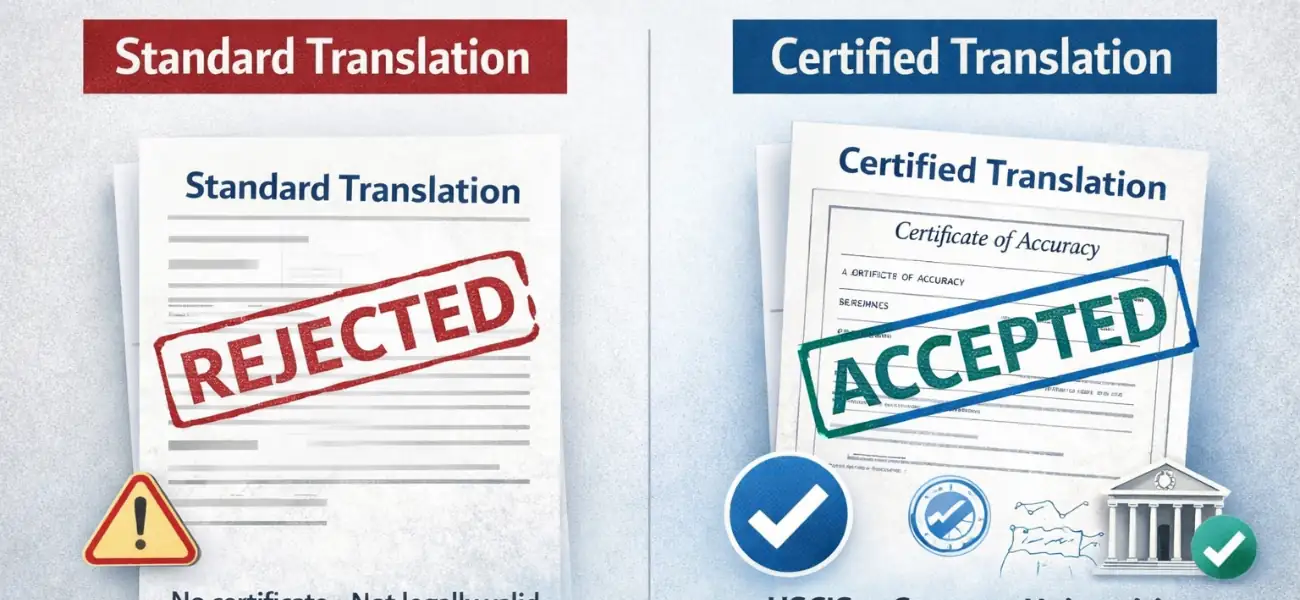
A certified translation is a document translated by a professional linguist, accompanied by a signed Certificate of Accuracy affirming it’s a true, complete representation of the source document. It’s a legal requirement for immigration, courts, and universities. For the full breakdown of what certified translation means and when you need it, see our complete guide to certified document translation.
A certified translation is not the same as a notarized one: certification focuses on the accuracy of the work itself, while notarization only verifies the identity of the person signing. Confusing the two is one of the most common reasons a submission gets sent back. See our certified vs. notarized translation guide for the full comparison.
Certified vs. Standard Translation: Key Differences
Which one you need depends on who’s going to read the finished document.
| Standard Translation | Certified Translation | |
|---|---|---|
| Best for | Business correspondence, internal memos, websites, personal letters | Government agencies, USCIS, IRCC, UKVI, and credential evaluators |
| Focus | Fluency and tone | Word-for-word precision and legal compliance |
| Requirement | No formal certification attached, meant for information-sharing rather than legal proof | A signed Letter of Accuracy on letterhead, with the translator’s credentials and contact information |
For standard translation needs, see our standard translation service.
When Is a Certified Translation Mandatory?
Certification is required in these specific situations:
Immigration and Vital Records
If you’re moving to the United States or Canada, USCIS and IRCC require certified translations for all non-English documents submitted with an application, no exceptions for documents you consider minor or self-explanatory. That includes:
- Birth certificates, the most common document requiring certification
- Marriage and divorce certificates, necessary for proving legal status or a name change
- Passports and ID cards, when the original script is non-Latin (Arabic, Cyrillic, Mandarin, and similar)
Academic Applications
Applying for an evaluation through WES or ECFMG? Most universities and credentialing bodies won’t accept a transcript unless it comes with a certified translation attached, including diplomas and degrees, course transcripts, and academic references.
Legal and Judicial Proceedings
In a courtroom, accuracy isn’t just a goal, it’s a legal mandate, since a mistranslated phrase in evidence can change the outcome of a case. Certified translations are required for affidavits and depositions, contracts and deeds, and police records and background checks. See our legal translation services for these document types.
The Risk of DIY Translation
AI translation tools are increasingly used for quick jobs, but for official documents this creates real risk. Machine translation fails for official use in three specific ways:
- Nuance blindness: a tool might translate a “civil registry” term correctly for one country’s legal system and incorrectly for another’s, since the same underlying English phrase can map to different legal concepts depending on jurisdiction.
- Lack of accountability: you can’t present an AI chat screenshot to a judge. Official use requires a human expert to sign off on the accuracy.
- Format sensitivity: official documents often have stamps, seals, and handwritten notes that automated tools skip or misread entirely.
Your Guarantee of Acceptance at Pro Translation Service
When your future is on the line, you need a guaranteed solution. We provide a 100% Acceptance Guarantee for USCIS submissions, backed by specialized human experts that AI can’t replace. AI can’t interpret official seals or legal nuance, but our certified translators are also subject-matter experts in law, medicine, and academia, which is what actually ensures accuracy for the authorities reviewing your document.
- 100% Acceptance Guarantee: we fix any certification issue at no cost.
- Specialized expertise: your document is matched with a translator from the relevant professional field.
- Recognized authority: our ATA membership means our certifications are trusted worldwide.
- Proven experience: thousands of successful immigration, academic, and legal submissions.
We use technology for speed, but every document gets a final human review for legal accountability before it ever reaches you. This means secure handling, 24-hour turnaround for simple documents, and confidence that what you submit will hold up.
Checklist: How to Order Your Certified Translation
Before you order, make sure of the following for the fastest turnaround, since most delays happen before translation even starts, not during it:
- Clear scans: all four corners of the document should be visible.
- Legibility: if there’s handwritten text, provide a typed key for names to avoid spelling errors in the translation.
- Target country: specify if the document is for the US, UK, or Canada, since formatting requirements vary slightly by destination.
Which One Do You Need? Quick Decision Guide
| If your document is going to… | You need… | Where to start |
|---|---|---|
| A government agency (USCIS, IRCC, UKVI) | Certified | USCIS, IRCC, UKVI |
| A court or legal proceeding | Certified | Legal translation |
| A university or credential evaluator (WES, ECFMG) | Certified | Academic translation, WES, ECFMG |
| Internal business use, personal reading, or a website | Standard | Standard translation |
If your document is for a government agency, a university, or a court of law, the answer is a resounding yes, you need certified translation. Everything else on that list is a standard-translation situation. Using a professional service for the certified cases builds your paperwork on a foundation of accuracy and legal compliance, rather than leaving it to a machine or an uncertified freelancer to guess at. Choosing the right one before you order is what keeps your paperwork moving instead of coming back for a redo.
Frequently Asked Questions
Order Your Translation Now & Get These
Features IN THE SAME PLACE:


Reviewed by Almu Jiménez - Spanish Localisation Expert