TL;DR: A certified translation includes the translated document plus a signed statement confirming accuracy and completeness. It does not require notarization, an apostille, or a government appointed translator for standard USCIS, UKVI, or IRCC filings.
If this is the first time you have needed a certified translation, the terminology alone can feel like a barrier before you have even found a provider. Between “certified,” “notarized,” “sworn,” and “apostilled,” it is easy to assume you need all of them just to be safe, when in reality most situations call for exactly one. This guide starts from the beginning: what a certified translation actually is, what you should expect to receive when you order one, and how it differs from a few other terms you are likely to run into along the way.
Certified Translation Defined
A certified translation is a translation of a document accompanied by a signed statement from the translator, or from a translation company on the translator’s behalf, confirming that the translation is complete, that it is accurate, and that the translator is genuinely competent to translate between the two languages involved. That signed statement is what makes it “certified,” as opposed to simply “a translation” someone happened to produce.
This is the standard that USCIS, UKVI, and IRCC all rely on for foreign-language documents submitted as part of an immigration filing, whatever the document type happens to be. It does not involve a government exam, a license, or approval from any official body. It is, at its core, a formal, signed declaration of accuracy from the person who did the work, and that simplicity is easy to underestimate when you are new to the process and expecting something more bureaucratically complicated.
What’s Included in a Certified Translation Package
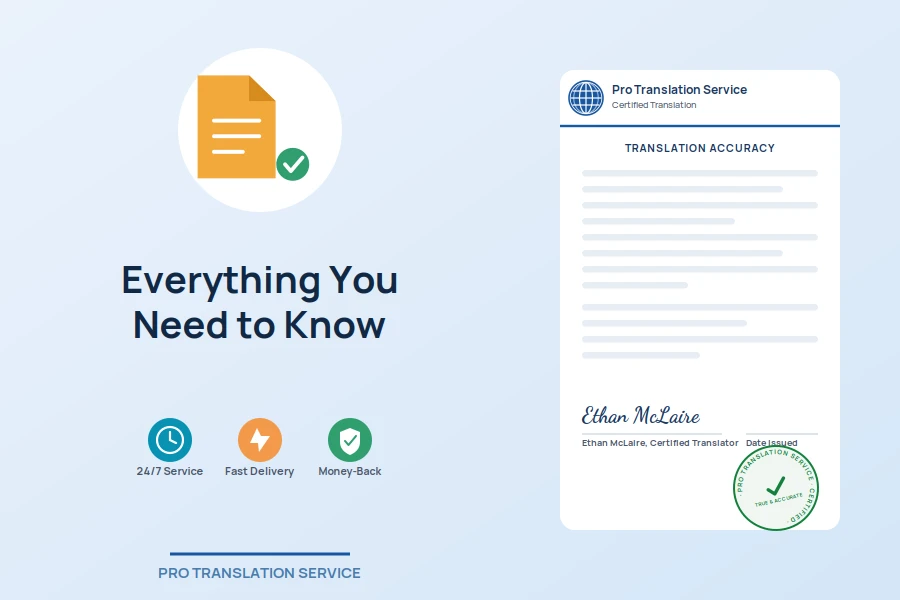
When you order a certified translation, you should expect to receive two things together: the translated document itself, formatted to closely mirror the layout of the original, and the signed certification statement, sometimes called a Certificate of Accuracy, either attached to the translation or accompanying it as a separate page clearly linked to the document it covers.
What’s Included, and What Isn’t
| Included | Not typically included (unless separately requested) |
|---|---|
| Full translation of the document | Notarization |
| Signed certification statement | Apostille |
| Translator’s name and contact information | Sworn or government appointment |
| Formatting that mirrors the original | Legal review or interpretation of the document’s content |
It is worth noting explicitly what is not automatically part of a standard certified translation package, since a few of these get assumed by default. Notarization, an apostille, and the kind of government appointment involved in sworn translation are all separate services that some situations genuinely call for, but none of them are included in, or required by, a standard certified translation.
What a Complete Package Looks Like in Practice
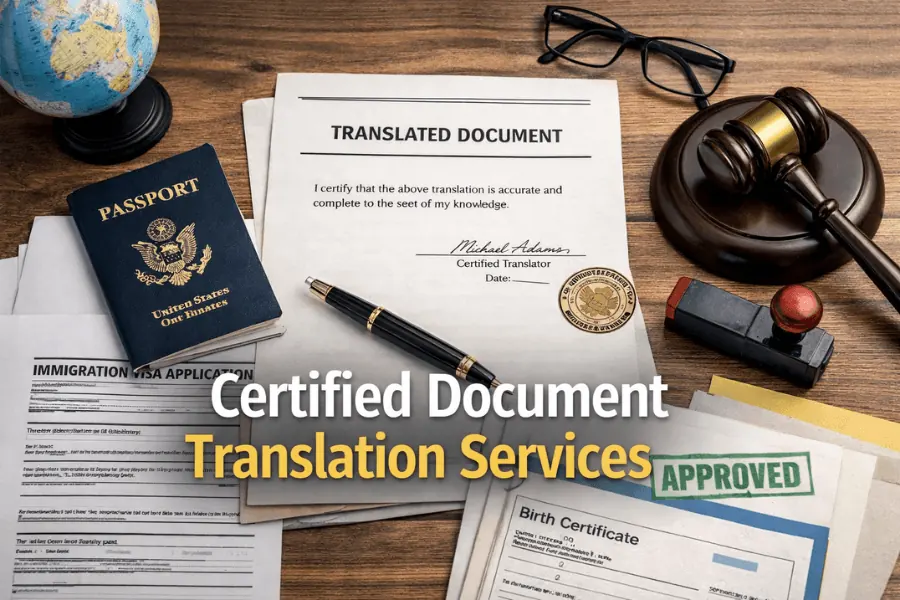
For a typical document, like a birth or marriage certificate, a complete certified translation package includes three physical or digital pieces: a copy of the original document for reference, the English translation formatted to mirror the original’s layout, and the signed Certificate of Accuracy. Some providers staple or bind these together as one submission-ready packet; others deliver them as separate files meant to be submitted together as a single unit. Either approach satisfies the underlying requirement, since neither USCIS, UKVI, nor IRCC mandate a specific physical format for how the pieces are assembled, only that all of them are present and complete.
What the Certification Statement Actually Says
There is no single official template that every certified translation is required to follow, but a compliant certification statement consistently covers the same core elements, all restated throughout USCIS’s own Policy Manual guidance: a declaration that the translation is a complete and accurate rendering of the original document, a declaration that the translator is competent in both the source language and English, and the translator’s signature and the date. Contact information for the translator or translation company is also expected, both as a best practice generally and as an explicit requirement under UKVI’s own translation standard specifically, and it is worth confirming this information is present before you submit anything.
The exact wording can vary somewhat between providers, and that variation is normal. What matters is that all of the core elements above are present, not that the phrasing matches any particular script word for word.
An Example of Compliant Wording
To make this concrete, a certification statement covering all the required elements might read something close to this: a declaration that the translator certifies they are fluent in both the source language and English, that the attached document is a true, complete, and accurate translation of the original document to the best of their knowledge and ability, followed by the translator’s printed name, signature, the date, and their business address, phone number, and email. The specific sentence structure and word choice can differ from provider to provider. What cannot vary is the substance: completeness, accuracy, competence, identity, and contact information, all present and clearly stated.
Where the Certification Goes on the Document
Conventions vary slightly between providers, but the certification statement is most commonly presented as its own dedicated page, attached directly to the translated document, rather than being embedded as a footnote or a stamp somewhere within the translation itself. This makes it easy for whoever is reviewing the document, whether an immigration officer or another institution, to see the certification clearly without having to search for it within the body of the translated text or flip through multiple pages looking for it.
Certified vs. Notarized vs. Sworn, in Brief
These three terms get confused constantly, and it is worth a brief, clear distinction here even though we cover this ground in much more depth elsewhere. A certified translation carries the translator’s own signed statement of accuracy, which is what USCIS, UKVI, and IRCC actually require for the vast majority of filings. A notarized translation adds a notary’s verification of the signer’s identity on top of that certification, which is not required for standard immigration filings even though it is a common and costly misconception that it might be. A sworn translation is a different system entirely, used in civil-law countries like France, Germany, Italy, and Spain, where only a court- or ministry-appointed translator can produce a translation with independent legal standing inside that specific country.
If you want the fuller explanation of all three, including exactly when each one applies, our complete guide to notarized vs. certified vs. sworn translation covers that ground in detail, including how sworn translation works differently across several individual European countries. If you are trying to understand the specific certification document itself, separate from the broader concept, our guide on what a Certificate of Accuracy is narrows in on that directly.
Common Mistakes First-Time Applicants Make
A handful of avoidable errors show up disproportionately often among people ordering a certified translation for the first time. Assuming the translation needs to be notarized is the most common, since notarization feels like a natural extra step for an “official” document even though USCIS and UKVI both explicitly do not require it. Translating the document yourself, or having a bilingual family member do it, is another common first-timer mistake, one that carries real risk of extra scrutiny even when the translation itself turns out to be accurate. And submitting a translation without the accompanying original document is a surprisingly frequent oversight, since a translation on its own, without the source document alongside it, is generally not sufficient evidence by itself.
Knowing these three pitfalls in advance is often enough to avoid all of them entirely, which is a large part of why we cover them directly rather than assuming they are obvious.
A Few Things Worth Checking Before You Submit
Once you receive your certified translation, it is worth a quick review before submitting it, even though you are trusting the translator’s expertise for the language itself. Confirm the certification statement includes a genuine signature, not a typed name. Confirm your name and any dates are spelled and formatted consistently with your other documents. Confirm every stamp, seal, or handwritten note visible on the original appears somewhere in the translation, even if only as a bracketed description of an illegible mark. None of this requires you to evaluate the translation’s linguistic accuracy, which is the translator’s responsibility, but catching a missing signature or an inconsistent name spelling before you submit is far easier and faster than fixing it after a caseworker flags it weeks later.
How to Order a Certified Translation
Once you know your document needs a certified translation rather than a notarized or sworn one, the process itself is straightforward: submit your document, receive a translation formatted to mirror the original, and receive the signed certification statement alongside it. If you are comparing providers and want to know what actually separates a reliable service from a risky one beyond generic advice, our guide on how to choose a reliable certified translation service covers exactly that. And if your question is specifically about who is allowed to prepare the certification in the first place, our guide on who can legally certify a translation answers that directly.
You can order your certified translation and receive a complete package: an accurate translation and a signed Certificate of Accuracy, prepared to meet the standard USCIS, UKVI, and IRCC all actually require of every filer. You can also place your order directly once you know exactly what you need.
Getting familiar with these basics before you order is genuinely useful, even if you end up working with a professional translation service for the actual work. Knowing what to expect, what the certification needs to say, and what a complete package looks like means you can review your finished translation with confidence rather than simply hoping it is right.
Frequently Asked Questions
Order Your Translation Now & Get These
Features IN THE SAME PLACE:


Reviewed by Weina Li - Chinese Language Translator & Trainer