

Quick answer: Certified translation rejections commonly come from a missing certification statement, an incomplete translation of stamps and seals, or the use of machine translation instead of a human translator. USCIS, courts, and universities each handle a rejection differently. A quick pre-submission checklist prevents most of these.

Certified translations are often required for important moments: immigration applications, court cases, academic admissions, business contracts and government filings. Translation problems can delay or derail these filings, and most of them are avoidable.
If you’ve ever wondered why a certified translation gets rejected even after paying for it, you’re not alone. The problem is rarely the document itself. In most cases, it’s how the translation was prepared, certified, or submitted.
A certified translation is a translated document accompanied by a signed statement from the translator confirming it’s complete, accurate, and prepared by someone competent in both languages. For the full breakdown of what certified translation means and who requires it, see our complete guide to certified document translation.
The 10 Most Common Reasons Certified Translations Get Rejected
Here are ten reasons translations fail approval, each with a way to avoid it.
1. Missing or Incorrect Certification Statement
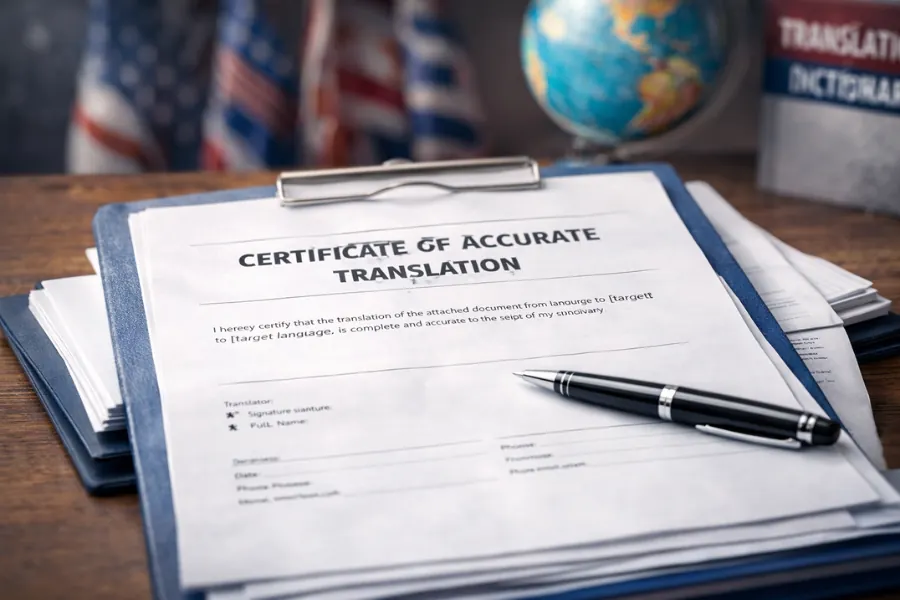
This is among the most common reasons certified translations are rejected. A translation alone is not enough. Authorities require a certification statement that declares accuracy and completeness and gives the translator’s full name, signature, date and contact information.
Common mistakes include generic or incomplete certification language, a forgotten signature, an unsigned PDF, or an outdated certification format. A missing element can lead USCIS to issue a Request for Evidence (RFE) or, at its discretion, deny the request. For example, a certificate with only a first name and no date is incomplete, even if the translation itself is flawless. USCIS’s Policy Manual chapter on evidence sets out the translation standard that officers apply.
How to avoid it: Always use a professional translation service that provides USCIS-compliant certification wording, included with every certified translation.
2. Confusing Certified Translation With Notarized Translation
Many applicants confuse the two. A certified translation confirms accuracy, while a notarized translation confirms the identity of the signer, so notarization does not replace certification. USCIS does not require notarization, but some other authorities ask for it. How to avoid it: confirm before you order whether you need certification only, certification plus notarization, or an apostille. Our guide on how certified, notarized and sworn translations differ explains each one.
3. Incomplete Translation of the Original Document
Authorities require complete translations, not summaries. What often gets skipped: stamps and seals, handwritten notes, marginal text, headers, footers, and annotations.
A single missing stamp can make the translation incomplete. Translators should describe each stamp, for example “Stamp: Ministry of Interior, dated March 14, 2022”, and not leave it out.
How to avoid it: Do not rely on automated tools, and have an experienced, independent translator handle the document. Professional translators are trained to identify and translate every visible element.
4. Poor Translation Quality or Errors
Even certified translations can be rejected if the content is inaccurate: incorrect names or spellings, wrong dates or number formats, mistranslated legal or medical terms, inconsistent terminology.
For example, “single” translated as “unmarried” when the original actually indicates “divorced,” or a date format switched between MM/DD/YYYY and DD/MM/YYYY, both raise red flags and can trigger additional scrutiny even though the rest of the document is accurate.
How to avoid it: Use experienced, human translators with subject-matter expertise, especially for legal, immigration, and academic documents.
5. Using Machine Translation or AI Tools
This is a growing problem. Tools like Google Translate or AI-generated translations can look accurate at a glance, but they miss context and misread legal language. A certified translation needs a human translator who takes responsibility for it, and an unreviewed machine translation does not provide that.
For example, free translation software can render a grading term as a literal, nonsensical phrase instead of the correct academic equivalent, which a reviewer notices at once.
How to avoid it: Only submit translations completed and reviewed by qualified human translators. AI can assist professionals, but it can’t replace certification or accountability.
6. Formatting That Does Not Match the Original Document
Formatting matters more than most people realize. Rejections happen when tables are removed, layout is altered, page numbers are missing, or paragraph structure is changed.
For example, a transcript’s original tabular grade layout collapsed into plain paragraphs during translation can lead an admissions office to send the whole document back for reformatting, even when every grade was translated correctly.
How to avoid it: Choose a service that preserves layout, formatting, and document structure exactly as required.
7. Wrong Language Pair or Regional Dialect Issues
Some languages have regional variants: Spanish (Spain vs. Latin America), Arabic dialects, and Chinese (Simplified vs. Traditional). The wrong variant can cause confusion or rejection, especially in legal or government contexts.
For example, a translator who uses Traditional Chinese conventions when the receiving office expects Simplified Chinese can raise unnecessary questions about the document. Confirm the expected variant with the authority.
How to avoid it: Work with professional translators who understand regional language requirements and official terminology.
8. Submitting Expired or Outdated Translations
Some institutions require translations to be recently issued or updated to match a revised original. Submitting an old translation for a newly issued document often leads to rejection.
For example, reusing a translation from several years ago after the underlying certificate has since been reissued in an updated format is a common, avoidable cause of rejection, since the translation no longer matches the current original.
How to avoid it: Confirm validity requirements before submission and use rush translation services when deadlines are tight.
9. Missing Page Numbers or Multi-Page Certification Errors
If your document has multiple pages, the certification must clearly apply to all of them. Mistakes include certifying only page one, missing page references, or separate files with no clear linkage between them.
For example, a three-page marriage certificate translation certified only on its first page can have its remaining pages treated as uncertified.
How to avoid it: Professional agencies ensure certifications explicitly cover the entire document.
10. Using an Unqualified or Anonymous Translator
USCIS and courts expect the translator to be identifiable and competent. Red flags include no translator name, no contact details, or a generic “certified by agency” statement with no individual named.
For example, a certification reading only “Certified by XYZ Agency” with no named translator can be rejected for lacking an identifiable, accountable person behind the certification.
How to avoid it: Always use a reputable translation service with transparent certification and accountability.
How Rejection Differs by Authority
What happens after a rejection isn’t the same everywhere:
- USCIS usually issues a Request for Evidence (RFE) or a Notice of Intent to Deny (NOID) before denying a case, giving you a chance to fix the defect, but it may deny without one when initial evidence is missing. The USCIS Policy Manual covers this process.
- Courts may exclude evidence with a defective translation without issuing a formal notice, which can be worse: the evidence simply does not count.
- Universities may place the application on hold pending a corrected translation, which can cost you an admissions cycle if it happens close to a deadline.
- UKVI and IRCC each run their own separate review processes, distinct from both USCIS and each other, so a rejection reason that applies to a U.S. filing doesn’t necessarily transfer to a UK or Canadian one.
For the full picture of what USCIS requires, see our complete guide to USCIS certified translation requirements, or our USCIS certified translation service.
An apostille authenticates the document itself for use abroad, which is different from both certification and notarization. For notarization and apostilles on birth certificates, see our guide on whether a birth certificate translation needs notarization or an apostille. If your document is headed abroad, the State Department’s apostille requirements page covers when that step applies.
How Pro Translation Service Helps You Avoid Rejection
Our process is built to prevent rejection and delays. We offer certified translations in all languages for legal, academic, immigration and business documents, with human quality checks, correct formatting and a complete certification. Standard delivery is within 24 hours for documents up to 3 pages, and rush delivery is 12 hours for $7 more per page. If the authority your translation was prepared for rejects it because of a translation problem, send us the rejection notice and we will refund your order in full. Free revisions are included for 14 days after delivery; after that, a small revision fee applies.
Documents Commonly Rejected Without Proper Translation
- Birth certificates
- Marriage certificates
- Divorce decrees
- Passports
- Academic transcripts and diplomas
- Court judgments and affidavits, see our legal translation services
- Medical records
- Business contracts, also covered under legal translation
Frequently Asked Questions
A rejected certified translation can delay visas, legal proceedings, admissions and business operations. Almost all rejections are preventable. Knowing the ten reasons above, and how your authority handles a rejection, is most of the work of avoiding one.
Order Your Translation Now & Get These
Features IN THE SAME PLACE:

Reviewed by Almu Jiménez, Spanish Localization Expert


