TL;DR: A certified document translation includes a complete English translation plus a signed Certificate of Accuracy. It’s required for USCIS, courts, and universities. It typically costs $22.99 to $60 per page and takes 1 to 5 business days, depending on document complexity.
Certified document translation services are essential when accuracy and legal acceptance both matter at once. If your documents aren’t translated correctly, they can be rejected by USCIS, courts, or universities, leading to delays and additional costs down the line. This guide explains how certified document translation works, when it’s required, and how to choose a reliable service.
Related guides in this series:
What Are Certified Document Translation Services?
Certified document translation services provide professional, accurate translations of official documents for legal, immigration, academic, and business use. Unlike regular translations, these services guarantee that the English version fully matches the original and includes proof of accuracy that a receiving authority can actually rely on. Professional agencies use human translators only for this work, machine translation isn’t part of a genuinely certified process at any stage.
These services matter when a government office, court, school, or business requires proof that the translation is reliable, not just readable or fluent. The final product includes the translated text plus a signed certification confirming completeness and correctness, which is the piece of paper that actually satisfies the receiving authority’s requirement.
What Makes a Translation “Certified”
A translation is certified when it includes a signed statement confirming accuracy, completeness, and the translator’s competence, not the translation quality alone. The certification must include the translator’s name, signature, contact details, and the date. Every stamp, seal, note, or handwritten part of the original must appear in the translation, no summaries or omissions allowed, even for elements that seem minor or purely decorative. This is what USCIS requires under 8 CFR 103.2(b)(3), the federal regulation behind this requirement.
Certified Translation vs. Standard Translation
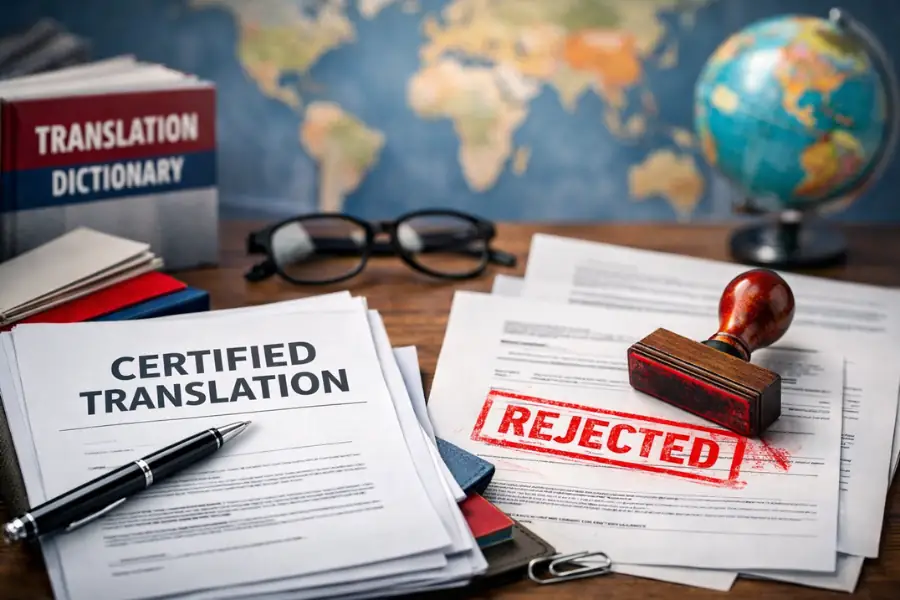
A standard translation simply converts text from one language to another. It may be fast and inexpensive, but it carries no legal guarantee of accuracy and isn’t designed to be. A certified translation includes the formal certification statement and is built specifically for official use. USCIS, courts, and universities almost always reject standard translations for exactly this reason, they lack the required proof of accuracy, not because the wording itself is necessarily wrong.
What Is a Certification Statement?
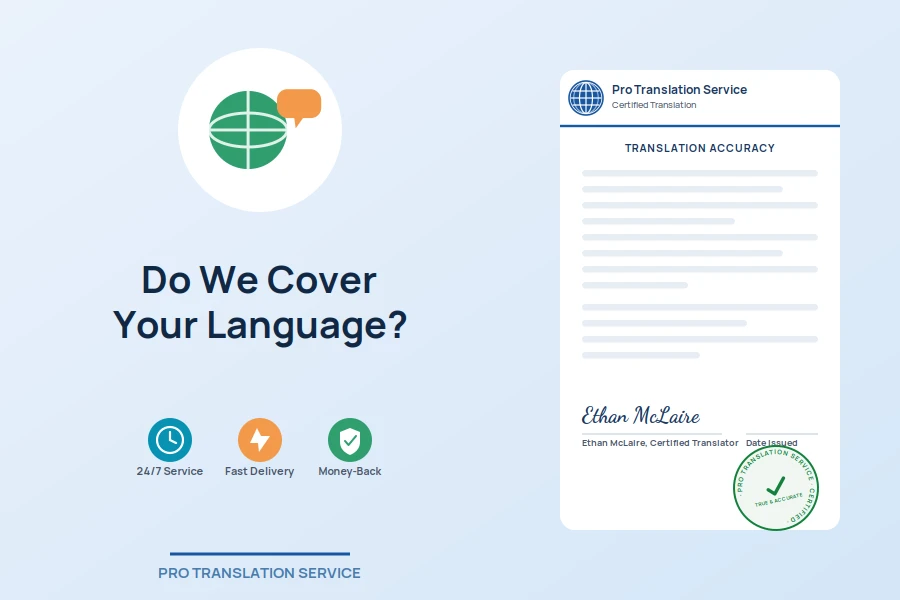
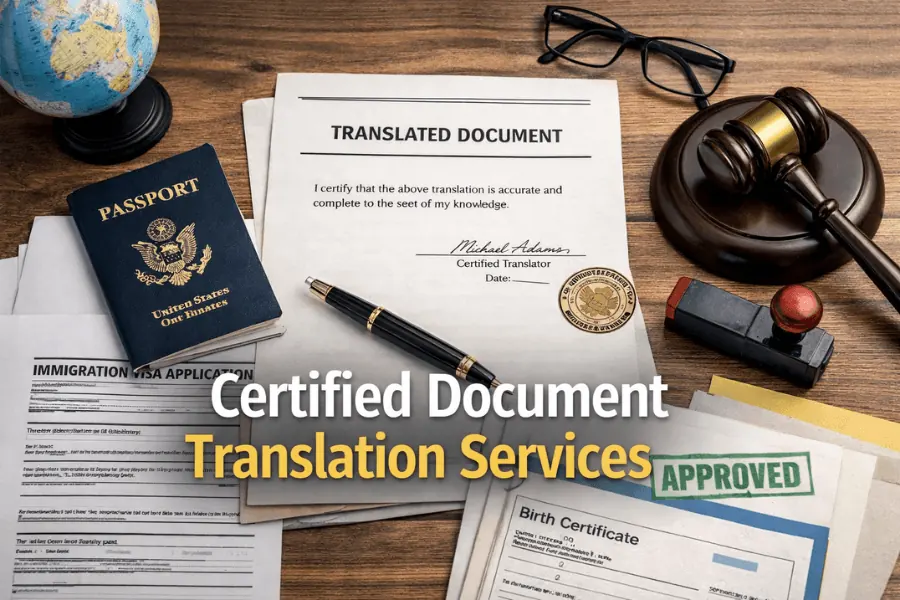
The certification statement is a short paragraph attached to the translation, not a separate document. A typical wording reads: “I [translator’s full name], certify that I am fluent in English and [source language], and that the attached/above document is an accurate and complete translation of the original document titled [document name].” It ends with the translator’s signature, address, and date, and this is the exact element every one of the common mistakes below traces back to when it’s missing or incomplete.
When Are Certified Document Translation Services Required?
Submitting an incorrect or uncertified translation can lead to rejection, delays, or a request for additional evidence, regardless of how good the underlying translation actually is.
Immigration and USCIS Requirements
USCIS requires that every non-English document be submitted with a complete English translation and a signed certification confirming accuracy and translator competence, no exceptions for documents you might consider self-explanatory. Failure to meet this requirement often results in a Request for Evidence (RFE) or rejection. See our full list of immigration authorities we translate for if your destination isn’t USCIS specifically.
Legal and Court-Related Documents
Courts across the United States accept only certified translations for evidence, contracts, affidavits, and judgments. Judges and attorneys rely on the certification to trust that nothing has been altered or omitted along the way. Uncertified translations can be excluded from proceedings entirely, regardless of how accurate the underlying translation actually is.
Academic and Educational Submissions
Universities, colleges, and credential evaluation services require certified translations of transcripts, diplomas, and degree certificates. Admissions offices need to verify every detail exactly as it appears in the original, and a certified translation is what lets them present your academic record clearly and professionally alongside the source document. If your evaluation is going through WES specifically, see our WES certified translation guide for the exact documentation rules.
Business and Official Documentation
Banks, government agencies, and international business partners often request certified translations of contracts, corporate papers, patents, and financial statements. Accurate, certified versions protect legal rights and speed up approvals that would otherwise stall on a question of whether the translated terms actually match the original agreement.
Documents That Require Certified Translation
Many official and legal documents require certified translation to be accepted by government agencies, courts, and institutions. The table below summarizes the most common categories, examples, and typical use cases across immigration, legal, academic, and official use, reflecting the documents requested most often in practice rather than an exhaustive list of every possible document type.
| Document Category | Examples | Common Use Cases |
|---|---|---|
| Personal documents | Birth certificates, marriage licenses, divorce decrees, death certificates | Immigration petitions, family-based visa applications, name changes |
| Academic documents | Transcripts, diplomas, syllabi, school records | University admissions, credential evaluations, employment verification |
| Legal documents | Contracts, powers of attorney, court orders, affidavits | Litigation, business transactions, estate planning |
| Medical & technical documents | Medical records, prescriptions, lab reports, technical manuals | Insurance claims, clinical trials, regulatory filings |
Personal documents such as birth certificates and marriage licenses are frequently required for immigration or family-based petitions. These short but highly detailed documents must be translated word-for-word, including all seals and handwritten notes, however minor they may look. For the specific requirements around birth certificates, see our guide on what makes a birth certificate translation certified. Academic documents demand particular precision, since even minor errors in course titles or grades can affect credit transfer or job offers. Legal documents require the highest level of accuracy, since every clause and legal term must be rendered correctly. Medical and technical documents can directly affect health and safety decisions, so accuracy is paramount. See our full documents we translate hub for the complete list.
How Certified Document Translation Services Work
Certified document translation follows a structured, multi-step process designed to ensure accuracy, compliance, and acceptance by official authorities such as USCIS and courts.
Submitting your documents: most services let you upload scanned copies of your originals through a secure online portal. Clear, high-resolution scans of both sides of each page speed up the process considerably compared to a single blurry photo.
Translation by a qualified professional: a human translator fluent in both languages and familiar with the specific document type performs the work. No machine translation is used at any stage, for the full reasoning behind this, see our guide on why professional translation beats AI tools. The translator converts every word, number, stamp, and layout detail while preserving the original meaning and format.
Editing and quality assurance: a second experienced linguist reviews the translation for accuracy, consistency, and completeness. This step is what catches potential issues before certification rather than after submission.
Certification and final formatting: the translator or agency representative adds the signed certification statement. The final file is formatted to match the original layout as closely as possible and delivered in PDF or whatever format you need.
Delivery and acceptance: you receive the certified translation by email or download, usually within the agreed timeframe, ready for immediate submission to USCIS, courts, or other institutions.
How Much Do Certified Document Translation Services Cost?
In 2026, reputable providers charge $22.99 to $60 per page for common language pairs, depending on complexity, length, and turnaround. Extremely cheap services outside this range often rely on machine translation or unqualified translators. The result can be an inaccurate translation that leads to a USCIS RFE, a court rejection, or a lost opportunity, and the small upfront saving usually costs far more in time, stress, and resubmission fees than it saved. A professional service that includes the certification statement as standard tends to pay for itself in reliability alone.
Several factors affect the final price:
| Factor | Typical Impact on Price | Example |
|---|---|---|
| Common language (Spanish, French) | Lower | $22.99–$35 per page |
| Rare language | Higher | $45–$75 per page |
| Simple personal document | Lower | Birth certificate |
| Technical legal text | Higher | Contracts with specialized jargon |
| Standard turnaround | Baseline | 2–3 business days |
Standard delivery (2 to 5 business days) costs the least. Rush options (24 hours or same-day) add a premium, but that premium remains far cheaper than the delays caused by a rejected application, and a good provider balances speed and price rather than charging a steep markup for urgency alone.
How Long Does Certified Document Translation Take?
Most simple documents, birth certificates or single-page diplomas, are typically completed within 1 to 3 business days. Multi-page academic transcripts or legal contracts typically take 3 to 5 business days. These timelines include translation, editing, certification, and quality checks. Rush and same-day options are available from many providers for straightforward documents.
Delivery speed depends on several factors: document length and complexity, language pair rarity, the current workload of the translation team, formatting or special layout requirements, and the overall volume of documents you’re submitting at once. Planning ahead and submitting clear scans shortens the wait more reliably than paying for rush service after the fact.
Common Mistakes in Certified Document Translation
Even small mistakes in certified document translation can lead to rejection, delays, or legal complications, which is exactly why it’s worth knowing what to avoid before you order rather than after a rejection notice arrives.
- Missing or incorrect certification statements: forgetting the certification statement, or using incomplete wording, is the top reason for rejection. The statement must be signed, dated, and contain the exact required declarations, not a paraphrased version.
- Inaccurate or incomplete translations: leaving out stamps, handwritten notes, or minor details creates discrepancies that USCIS or courts will flag, even when the main body text was translated correctly.
- Formatting and layout issues: a translation that doesn’t match the original’s margins, tables, and page order can confuse reviewers trying to compare the two documents side by side.
- Using unqualified translators: a fluent family member or friend still lacks the professional training and impartiality authorities require, and USCIS often questions self-translations specifically for this reason.
For the full breakdown of these and other rejection causes, see our guide on why certified translations get rejected.
Certified vs. Notarized Translation
Certified translation and notarized translation serve different purposes, and confusing them can mean submitting the wrong type of document entirely.
Notarized translation, defined: a notary public verifies the identity of the person signing the certification statement. The notary does not check the accuracy of the translation itself, they only confirm that the signature is genuine.
The key difference: certified translation focuses on the accuracy and completeness of the translated content. Notarized translation focuses only on the authenticity of the signer’s identity. USCIS requires certified translations and, as a matter of longstanding policy, does not require notarization. Some universities or foreign governments may request both, but certified alone satisfies most U.S. needs.
Certified vs. Sworn Translation: A Note for International Clients
In many countries outside the United States, particularly in Europe and Latin America, the term “sworn translation” is used instead of “certified.” A sworn translation is performed by a translator officially authorized by a government body or court, a different system from the U.S. self-certification model. While the terminology differs, a U.S. certified translation serves the same underlying purpose, providing the legal guarantee of accuracy that authorities expect.
If your document is destined for a foreign government or an international organization, confirm directly whether they require a sworn translation specifically or will accept a standard U.S. certified translation instead. Most U.S.-based certified translation services, including this one, can advise you on which applies to your specific destination. Our legal requirements by country guide covers which countries require a sworn translator by name.
When Notarization Is Required
Notarization may be needed for certain passports, apostilles, or documents going to specific foreign authorities that explicitly ask for it. In those cases, you can request the extra step directly from your translation provider rather than seeking out a separate notary afterward. For standard USCIS filings, certified document translation alone is sufficient, adding notarization you weren’t asked for just adds cost and time without any benefit.
Who Can Provide Certified Document Translation Services?
Not all translators or services meet the standard required for certified document translation, which makes choosing a qualified provider essential.
Professional translators and agencies: experienced agencies that employ full-time human translators deliver consistent quality and reliable certification, and understand USCIS expectations well enough to handle large volumes efficiently without cutting corners.
ATA-certified translators: the American Translators Association (ATA) offers a rigorous certification exam that tests professional translation skills directly. ATA certification isn’t required by USCIS, but it signals a real level of expertise and is often preferred for complex legal or technical work specifically.
Requirements for certification: any competent translator can technically provide a certified translation as long as they sign the required statement, since USCIS doesn’t mandate a specific license, exam, or professional membership for this. In practice, professional agencies maintain quality controls, use native-level linguists, and stand behind their work in ways an individual translator working alone typically can’t replicate.
USCIS technically allows self-translation, though it’s strongly discouraged and reviewers may view it as biased even when the translation itself is accurate. For the full discussion of why self-translation is risky, see our guide on translating a birth certificate.
How to Choose a Certified Document Translation Service
Making the right choice protects your timeline and your application, not just your budget.
Key factors to evaluate: a USCIS acceptance record, 100% human translators with no machine translation, transparent per-page pricing with no hidden fees, realistic turnaround times, inclusion of the certification statement, secure file handling, and positive client reviews.
Red flags to avoid: prices far below market average, promises of machine translation, no mention of certification, unclear contact information, or no sample certification statement available on request. Any one of these on its own is worth a second look before you commit your document to that provider.
Questions to ask before hiring: Do you use only human translators? Is the certification statement included? How quickly can you deliver for my language pair? Have your translations been accepted by USCIS recently? What’s your policy if the document is rejected? A provider that answers all five clearly and specifically, rather than with general marketing language, is usually the safer choice.
Frequently Asked Questions
Certified document translation services play a vital role in immigration, legal, academic, and business success. Choosing a professional provider that delivers accurate, fully certified translations helps you avoid delays, reduce stress, and increase the chances of approval on the first submission.
When your documents need to hold up to USCIS, a court, or a university’s scrutiny, getting the certification right the first time matters more than saving a few dollars per page. A properly certified translation, done once and done correctly, protects your timeline in a way that a cheaper redo never quite makes up for.
Order Your Translation Now & Get These
Features IN THE SAME PLACE:


Reviewed by Asma Safi - English-Arabic Medical & Immigration Translator