TL;DR: A birth certificate translation is certified when it includes a signed statement from the translator confirming completeness, accuracy, and their competence in both languages, not a government license. USCIS doesn’t require notarization for most filings. Some countries require a sworn translator or an apostille instead.
A birth certificate is more than a record of birth. It’s a legal key to passports, visas, citizenship, marriage registration, education, and immigration benefits, often the single document everything else in an application gets checked against.
But when that document is in another language, a simple translation isn’t enough. Authorities require a certified translation that guarantees accuracy, completeness, and legal validity. This guide explains exactly what makes a birth certificate translation certified, the certification process, common mistakes to avoid, and how to choose a trusted service, so your document is accepted the first time rather than sent back for a fix you could have caught upfront.
Understanding Certified Translations
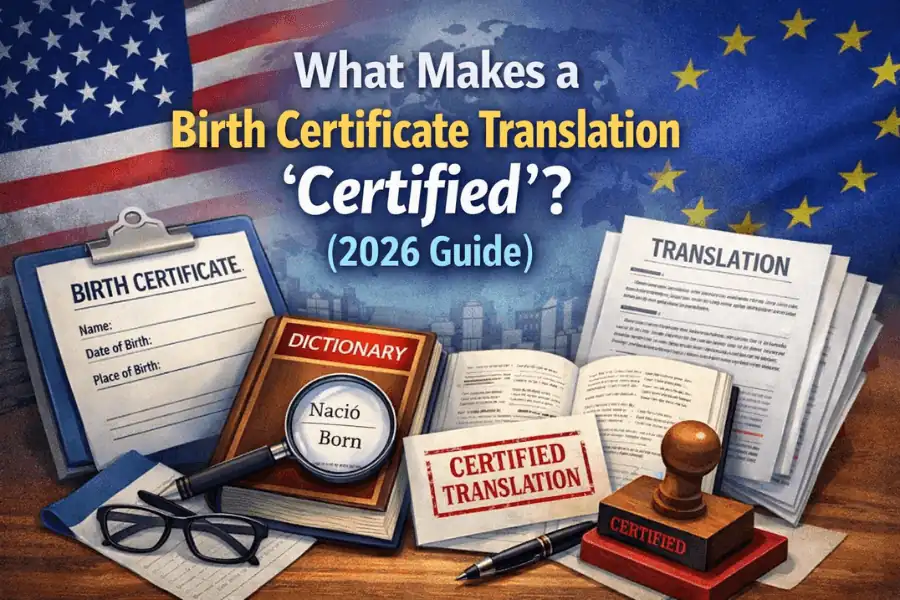
A certified translation is a legally binding assurance that the translated document faithfully mirrors the original in every detail, from the wording to the intent behind specific administrative phrasing. The translator attaches a signed statement affirming the work is complete and accurate, including their name, signature, address, and the date, creating a trail of accountability that institutions like USCIS can follow if a question ever comes up later. In the United States, this doesn’t require a government-issued license, but it does require that transparency, since the certification is what puts the translator’s professional reputation directly behind the work.
For the fuller picture of what certification means across document types generally, not just birth certificates, see our complete guide to certified document translation.
Special Considerations for Birth Certificates
For birth certificates specifically, the stakes are higher because of the document’s intricate elements: official seals, registrar stamps, marginal notes, and sometimes corrections or amendments added over time, occasionally by hand. A certified translation must replicate all of these accurately, describing non-translatable elements like emblems or watermarks in clear bracketed terms, for example “[Official Seal: Ministry of Civil Registry]” rather than simply leaving that part of the document blank or assuming it doesn’t matter. The goal is a document that looks and functions like the original, just in the target language, down to details that have no direct linguistic equivalent.
This rigor protects against misunderstandings that lead to rejected applications or disputes over identity, the exact outcomes a certified translation exists to prevent in the first place, not just a bureaucratic box to check. Demand for this kind of precision keeps growing too: the UN Population Division’s most recent estimate puts the international migrant stock at 304 million people as of 2024, each one a potential need for a certified translation of exactly this kind of document.
Why Birth Certificates Need Certified Translations
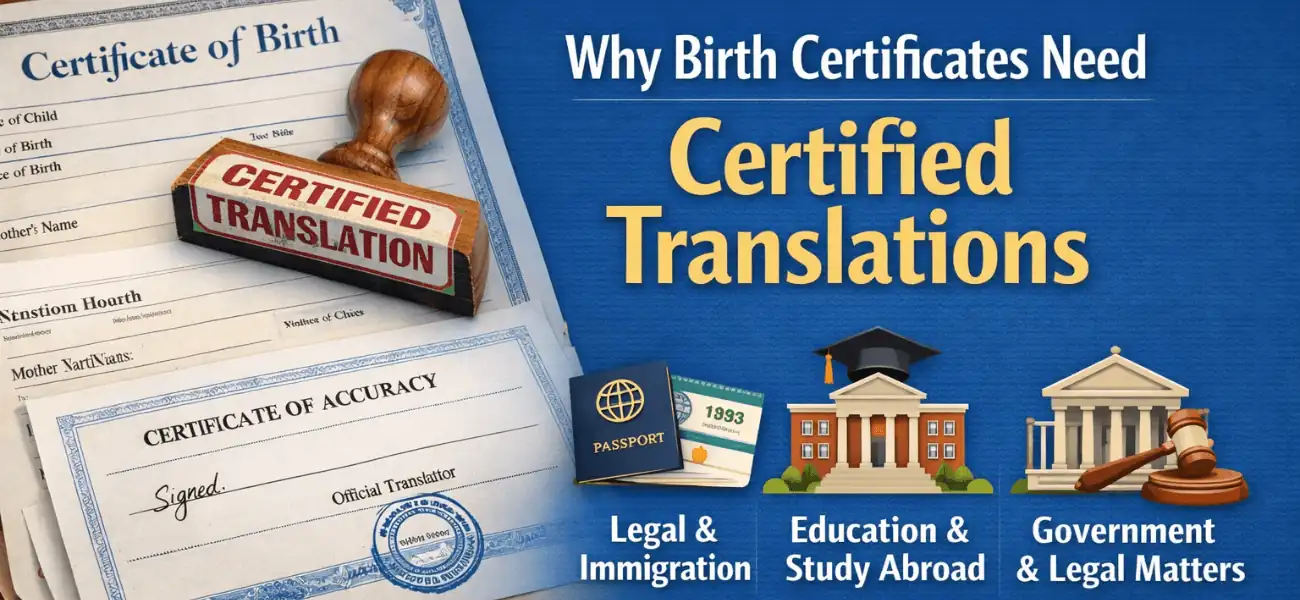
Birth certificates surface in countless life milestones, serving as the foundational proof of identity. Whether you’re pursuing a visa, enrolling in school overseas, or handling inheritance matters, this document often stands at the center of the whole process. In immigration contexts specifically, it verifies age, parentage, and nationality, elements that can make or break an application on their own. Without a certified translation, even the most straightforward process can grind to a halt over a technicality that has nothing to do with your actual eligibility.
U.S. Requirements
USCIS requires certified translations for all foreign-language documents in green card applications, naturalization filings, family-based petitions, and other immigration and visa processes. This requirement exists specifically to prevent identity errors like misspelled names, incorrect dates of birth, or mismatched parental details from slipping through unnoticed. Even minor inaccuracies here can trigger delays, a Request for Evidence, or an outright denial, regardless of how strong the rest of the application is.
Risks of Inaccuracy
Certification exists precisely because inaccuracies carry real legal and identity risk, not just an administrative inconvenience. A simple error, like confusing a middle name with a surname, or transposing a day and month in a date of birth, can lead to identity verification failures or legal complications well down the line, often long after the original translation itself has been forgotten about.
The Role in Immigration and Legal Processes
Beyond basic identification, birth certificates play pivotal roles in complex legal scenarios that go well past a routine visa application. For asylum seekers, a birth certificate might substantiate claims tied to age or family ties central to the case itself. In adoption cases, it confirms biological relationships, or the documented absence of them. Certified translations ensure these sensitive details are conveyed without distortion, which matters enormously for preserving the integrity of the proceeding as a whole.
Everyday Applications
Even outside formal immigration, certified translations prove useful in ways people don’t always anticipate: applying for dual citizenship, registering a child for school in a new country, or handling a cross-border inheritance all often hinge on having accurate, certified documentation ready to go. Having a certified version on hand ahead of time, rather than scrambling for one under deadline pressure, saves both repeated effort and cost later.
Requirements vary meaningfully by destination, Germany and France require sworn court-appointed translators rather than the U.S. self-certification model, for instance. For the full country-by-country breakdown, see our legal requirements by country guide.
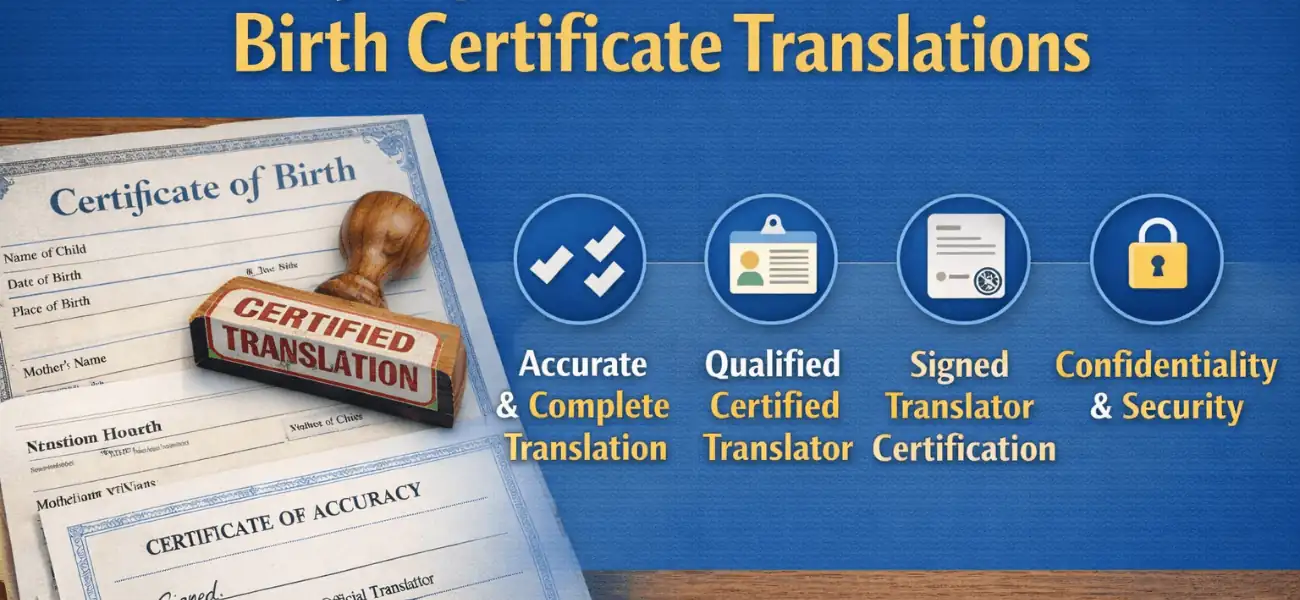
Key Requirements for Certified Birth Certificate Translations
Achieving certification for a birth certificate translation means meeting a set of non-negotiable standards, drawn from USCIS policy and international best practice, all of which prioritize completeness and verifiability over speed.
Completeness Rules
The translation must cover every element of the original document: all printed text, handwritten entries, and any annotation on the back of the page, not just the fields that look most important. Seals, stamps, and signatures need descriptive translations, such as noting “Official Seal of the Registrar,” rather than being skipped because they aren’t conventional text a translator might otherwise gloss over. Omissions, even minor ones that seem inconsequential, can invalidate the entire submission regardless of how well the rest was handled.
What the Certification Statement Must Include
- A declaration that the translation is complete and accurate
- The source language and the target language
- The translator’s full name
- Their signature
- Their address and phone number
- The date of certification
USCIS accepts digital signatures, which makes fully digital certified translations legally valid, not just a convenience for faster delivery. Missing even one of these six elements is enough on its own to invalidate an otherwise accurate certification statement.
Translator Qualifications
No formal U.S. certification license is mandatory, but the translator must demonstrate real proficiency through documented experience or education, not just self-reported fluency. USCIS discourages using relatives or self-translations, viewing them as inherently biased regardless of how accurate the actual wording turns out to be. Professional agencies typically employ linguists with specialized knowledge of legal terminology specifically, so that regional dialects and legal-specific phrasing get handled correctly rather than translated too literally into something that reads oddly to a native speaker.
Formatting Guidelines
The translated document should mirror the original’s layout as closely as reasonably possible, tables, line breaks, and the positioning of key elements included, since this visual fidelity is what lets a reviewer cross-reference details quickly against the source document. For international use, some countries require an apostille, a separate authentication step under the Hague Convention, but USCIS typically does not, a distinction worth knowing before you pay for a step you don’t actually need.
Handling Special Features
Documents from older eras sometimes feature archaic language, handwritten entries in cursive, or faded ink that’s genuinely hard to read. A professional translator describes illegible parts transparently, noting “[illegible]” directly in the translation rather than guessing at what the text might plausibly say, since a confident-sounding guess that turns out wrong is worse than an honest gap.
The Certification Process, Step by Step
Getting a birth certificate translation certified is a methodical process, even for someone completely new to it, and advances in digital tools have made it more efficient than ever, particularly through online-first providers.
Initial preparation: begin by scanning or photographing your birth certificate. Ensure high resolution to capture fine details like seals or watermarks that a lower-quality scan might blur into illegibility. Include all pages, front and back, since an incomplete scan is one of the most avoidable causes of a delayed order.
Selecting a provider: choose a reputable translation service with a proven track record specifically in official documents, ideally verified through client reviews or professional affiliations like the American Translators Association, rather than a general-purpose translation site that happens to also offer this as one of many services.
Submission and payment: submit your scan through the provider’s secure portal, specifying the target language and any deadline you’re working against. Fees typically reflect the document’s complexity and the urgency you’ve requested, not a flat rate regardless of circumstances.
Translation execution: once processed, a professional human translator begins the actual work. Many providers use software to help produce an initial draft faster, but a manual review by the translator is what catches cultural or contextual subtleties that automated tools consistently miss.
Final certification: upon completion, the translator attaches the certification statement, detailing their credentials and affirming both accuracy and completeness. You receive digital copies and, if requested, physical ones. For USCIS submissions specifically, pair the certified translation with the original document or a certified copy of it.
This process typically delivers certified translations within 24 to 48 hours, with many providers offering an acceptance guarantee that promises revisions at no extra cost if the receiving authority raises a concern. For the fuller walkthrough of the online version of this process specifically, see our guide on online birth certificate translation services.
Choosing the Right Translation Service
Human expertise remains hard to replace for certified work, where context and subtlety matter as much as literal accuracy. AI tools are fast, but they still falter on legal precision in ways that lead to rejections USCIS attributes specifically to the translation, not the underlying application.
When evaluating a service, look for real experience with official documents specifically, not general translation work aimed at business or casual use. Specialization in birth certificates or immigration documents is a good signal on its own, as is coverage of your specific source language, including less common ones like Tagalog or Amharic that not every provider staffs for on short notice. Turnaround of 24 to 48 hours is standard for urgent needs, and a service that offers free revisions or a refund if the translation isn’t accepted is signaling real confidence in its own work rather than just marketing language aimed at closing the sale.
Be cautious of prices well below the market range, since that’s often where corners get cut, on certification wording, on quality review, or on translator qualifications, rather than on the visible translation quality alone. Check for memberships in recognized professional organizations and years of experience specifically with official document types, since a portfolio of general translation work doesn’t tell you much about how a provider handles a birth certificate’s specific seals and formatting requirements.
Security matters too. A reputable service should use encryption for uploads and storage, and typically operates under a confidentiality or non-disclosure policy, since a birth certificate contains exactly the kind of sensitive personal information that shouldn’t be handled casually by anyone along the way, from upload to final delivery.
What Happens If a Translation Isn’t Certified?
An uncertified translation, however accurate the wording, is typically rejected outright by USCIS and similar authorities, since the certification statement itself is the actual requirement being checked, not just a formality layered on top of otherwise-sufficient work. In practice this usually means a Request for Evidence rather than an immediate denial, but that still adds weeks to a timeline that a properly certified translation would have avoided entirely. For the full breakdown of this and other common rejection causes, see our guide on why certified translations get rejected.
How Long Is a Certified Translation Valid?
A certified translation itself doesn’t expire the way a background check or a medical exam typically might. The certification statement attests to the accuracy of the translation at the time it was made, and that doesn’t change with the passage of time or the calendar. What can create a real problem is if the underlying original document gets reissued or amended after the translation was done, in that case, the translation no longer matches the current version of the original, and a receiving authority may reasonably ask for an updated one even though nothing was technically ever “wrong” with the old translation.
Because of this, it’s worth keeping a certified translation on file once you have one, rather than reordering it every time you need it for a new application. It’s also worth checking whether your specific birth certificate has been reissued in a new format since your last translation was done, since some countries periodically update the design or layout of vital records, which can make an otherwise-accurate old translation look inconsistent with the current original.
Costs Involved in Certified Birth Certificate Translations
Pricing depends mainly on language pair, urgency, and any additional authentication needed, rather than on the length of the document itself, since most birth certificates run a single page regardless of language. Expect $22.99 to $60 per page for common languages like Spanish or Mandarin. Rarer languages, Swahili or Khmer among them, command higher fees due to limited translator availability for that specific pair. Expedited 24-hour service adds a premium on top of the base price, and notarization, when a specific court or authority requires it, typically adds another $10 to $25. An apostille, when needed for international use, runs separately through your state’s authentication office and isn’t something your translation provider issues directly.
If you need multiple documents translated together, birth certificate plus marriage certificate plus a diploma, for example, ask about bundled pricing, since ordering them separately from different providers usually costs more overall and risks inconsistent formatting conventions across documents that may need to be submitted together as a single packet.
Common Mistakes to Avoid
- Overlooking the certification statement entirely, the single most common reason for outright rejection, even when the translated text itself is flawless.
- Incomplete translations that skip stamps, seals, or marginal notes, creating gaps that raise suspicion even when the main body text is accurate, since a reviewer can’t tell whether something was omitted deliberately or overlooked entirely.
- Using family members for translation, which invites a bias objection regardless of the translation’s actual accuracy, since authorities can’t verify impartiality after the fact.
- Relying solely on AI tools, which skips the human review that catches context-specific nuance a machine typically misses, especially around legal or administrative terminology.
- Mismatched formatting that doesn’t follow the original’s structure, which confuses reviewers trying to compare the two documents side by side.
- Inconsistent name spellings between the translation and your other identity documents, even a single-letter difference can raise a flag.
- Adding unnecessary notarization when the receiving authority only asked for certification, which wastes time and money without improving your odds of acceptance.
Comparing the translation against the original side by side, and getting a second opinion where possible, catches most of these before submission, when they’re still easy and cheap to fix.
Global Perspectives, in Brief
Approaches to certification vary by country in ways that go well beyond simply translating into a different language. The EU generally allows official-language documents to bypass translation for administrative use between member states, but non-EU birth certificates typically still need certified versions for residency, marriage, or employment purposes. Germany and France require sworn, court-appointed translators rather than the U.S. self-certification model, a genuinely different system, not just stricter paperwork. Canada’s IRCC accepts certified professionals, with a sworn affidavit required if the translator isn’t officially certified. Australia requires NAATI-accredited translators specifically for immigration and government use, and won’t accept a generic certified translation in their place.
Japan, meanwhile, favors translations from registered professionals for official filings, another variation on the same underlying theme: every country decides for itself who counts as a trustworthy translator, and that decision doesn’t automatically transfer from one jurisdiction to another. For the complete country-by-country breakdown, including specific notarization and apostille requirements, see our legal requirements by country guide.
Frequently Asked Questions
Certified birth certificate translations aren’t just a technical requirement, they’re a foundation of trust in legal, immigration, and international systems. Accuracy, completeness, and proper certification protect your identity, your applications, and your future opportunities, in ways that are easy to overlook until something goes wrong with a document you assumed was fine. Understanding what certification actually requires, and avoiding the common mistakes above, is most of the work of getting it accepted the first time, rather than finding out what was missing only after a rejection notice arrives.
Order Your Translation Now & Get These
Features IN THE SAME PLACE:


Reviewed by Verena Gale - Certified Court Translator: German, Slovene, English