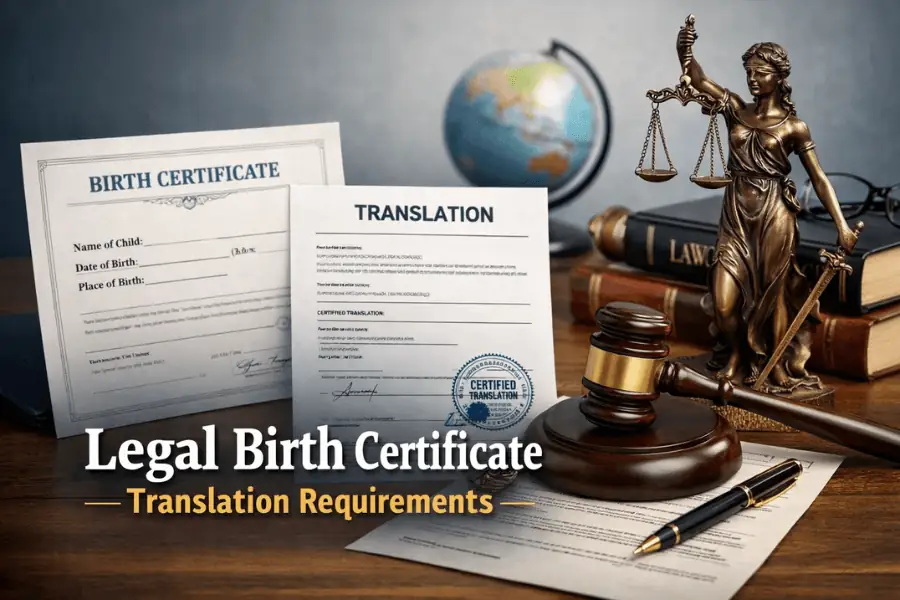
TL;DR: Legal requirements for birth certificate translation vary by authority. USCIS requires certification only. Some courts and foreign consulates require notarization or apostille. Some countries require a “sworn” translator instead of a certified one. Check the country table below before ordering.
Knowing how to submit a birth certificate translation is only half the job. The other half is knowing what your specific authority actually requires: a certified translation, a notarized one, a sworn translation from a government-registered translator, or an apostille on top of all three.
Those requirements are not the same everywhere. The same translated document that satisfies USCIS can be rejected outright by a German registry office or a Spanish consulate, not because the translation is wrong, but because it’s the wrong type of translation for that authority.
This guide breaks down what changes by authority and by country, so you order the right thing the first time.
How Legal Requirements Differ by Authority Type
Every receiving authority sets its own translation standard, and treating them as interchangeable is one of the most common causes of rejected documents. A translation that satisfies USCIS will not automatically satisfy a UKVI caseworker, an IRCC officer, or a foreign court.
- USCIS: requires a certified translation, a complete English version plus a signed statement confirming accuracy and translator competence. USCIS’s own filing guidance confirms this directly. Notarization is not required unless a specific form or office asks for it. Full detail is in the USCIS Policy Manual.
- UKVI: requires a certified translation whenever the original isn’t in English or Welsh. Notarization is a common misconception here. Standard UKVI submissions do not require it.
- IRCC (Canada): requires a certified or sworn translation, and Canada’s 2024 accession to the Hague Apostille Convention means the underlying document itself may also need an apostille for some immigration streams.
- ECFMG: requires certified translation of medical credentials, under its own document-specific rules that sit outside general immigration translation standards.
If your authority isn’t one of these four, see our full list of immigration authorities we translate for.
If you’re using a foreign birth certificate as citizenship evidence for a U.S. passport application rather than an immigration filing, that’s a separate process with its own accepted-document list, covered on the State Department’s citizenship evidence page.
Country-by-Country Requirements at a Glance
This table reflects each authority’s current, publicly stated policy. Confirm directly with the receiving authority before relying on it for a specific filing, since requirements do change.
| Country/Authority | Certified Translation Required | Notarization | Apostille/Legalization | Notes |
|---|---|---|---|---|
| USA (USCIS) | Yes, full translation including seals and stamps | No, unless specifically requested | Only relevant for outgoing U.S. documents used abroad, not incoming foreign documents | A signed certification statement is the core requirement |
| Canada (IRCC) | Yes, in English or French | Sworn affidavit if the translator isn’t officially certified | Yes, Canada acceded to the Hague Apostille Convention, in force since January 11, 2024 | Required for Express Entry and most other immigration streams |
| UK (UKVI) | Yes, if the original isn’t in English | Not required for standard visa or immigration submissions | Can apply for certain non-immigration legal matters, not for routine visa filings | A signed declaration of accuracy from the translator is sufficient; notarization is a frequent misconception |
| Australia | Yes, NAATI-accredited translator required for documents translated within Australia | N/A, accreditation replaces this step | Check per use case | Mandatory for Department of Home Affairs submissions |
| Germany | No, a “sworn” translation (beglaubigte Übersetzung) is required instead | N/A, the sworn translator’s own seal serves this function | Required for some civil registry and diploma-recognition procedures | Only translators court-appointed as vereidigter or ermächtigter Übersetzer are accepted; a US-style certified translation is often rejected outright |
| Spain | No, a sworn translation (traducción jurada) is required instead | N/A, the sworn translator’s stamp and registration number serve this function | Yes, typically required on the underlying document for immigration and civil procedures | Only translators on Spain’s Ministry of Foreign Affairs (MAEC) registry are accepted; notarized U.S. translations are commonly rejected |
| UAE | Yes, Ministry of Justice-approved provider | N/A | Not applicable. The UAE is not a Hague Apostille Convention member | Documents require full legalization/attestation through the Ministry of Foreign Affairs and International Cooperation (MOFAIC) instead, a separate system unrelated to the Hague Convention |
| EU (general) | Yes, unless a multilingual standard form applies | Varies by member state | Yes, apostille standard between Hague member states | Standard multilingual forms can sometimes replace translation entirely for certain civil status documents |
For destinations not shown here, see our full list of countries we cover. For the basics of the certified translation process itself, start with our birth certificate translation guide.
When Sworn Translation Is Required Instead of Certified
Several countries, including Spain, France, Germany, and Italy, use a “sworn” translator system instead of the U.S. self-certification model.
In these countries, only a translator personally appointed or registered with a court or ministry can produce a legally valid translation. Their stamp and registration number, not a general certification statement, is what makes the document acceptable.
Germany illustrates this well. A translator does not become “sworn” by being skilled or experienced. They are appointed by a regional court (Landgericht) after taking a formal oath, and only their registered seal, showing the exact wording “öffentlich bestellter und vereidigter Übersetzer,” carries legal weight with German civil registries and immigration offices.
Spain works the same way through a different registry. A traductor jurado is appointed directly by Spain’s Ministry of Foreign Affairs (MAEC), and their stamp and personal registration number are what Spanish institutions check, not the translator’s general certification credentials.
This matters most when a birth certificate translation is going to a foreign court, a foreign consulate, or a foreign civil registry rather than to a U.S. authority. Always confirm with the receiving office whether they require a sworn translator registered in that specific country, since a U.S.-style certified translation may not be accepted there at all.
When Apostille Is Legally Mandatory vs. Optional
An apostille authenticates the signature and seal on a public document. It says nothing about whether a translation is accurate.
It is only mandatory when the receiving country is a member of the Hague Apostille Convention and specifically requires it for the type of submission you’re making, most often court filings, property transactions, or certain consulate procedures.
It is unnecessary for routine USCIS immigration filings, since USCIS evaluates the certified translation itself rather than the apostille status of the underlying document. For U.S.-issued documents that do need one, the State Department’s apostille requirements page explains the process.
It is also not a substitute for the correct translation type. An apostilled document sent to Germany still needs a sworn translation, not a certified one; the apostille and the translation type answer two entirely different questions.
What Happens When You Use the Wrong Type of Translation
Getting the translation type wrong costs more time than getting the translation itself wrong, because the fix usually means starting over with a different translator entirely.
- USCIS: a translation missing the signed certification statement typically triggers a Request for Evidence, adding weeks to processing rather than an outright denial.
- Germany: a standard certified translation submitted to a Standesamt (civil registry) or Ausländerbehörde is commonly rejected in full, since only a court-appointed sworn translator’s seal is accepted there.
- Spain: the same pattern applies. A notarized U.S. translation presented to Spanish immigration or a Spanish consulate is routinely turned away for not being a traducción jurada from a MAEC-registered translator.
- Apostille mismatches: paying for an apostille the receiving authority never asked for wastes money and time, while skipping one that was actually mandatory can stall an application at the final step, after the translation itself was already done correctly.
The pattern across all four is the same: the translation can be linguistically perfect and still get rejected, because the receiving authority is checking for a specific legal format, not just accuracy.
Quick Checklist Before You Order
A few minutes of confirmation upfront avoids weeks of delay later. Before ordering a birth certificate translation, confirm the following with the receiving authority or office:
- The exact name of the authority receiving the document (USCIS, a specific consulate, a specific civil registry, a specific court), since “immigration” alone isn’t specific enough.
- Whether that authority wants a certified translation, a sworn translation from a translator registered in that country, or both.
- Whether notarization is actually required, or is being requested out of habit rather than an actual rule. UKVI is the clearest example of this distinction in practice.
- Whether an apostille is required on the underlying document, on the translation, on both, or on neither.
- Whether the country in question is a Hague Apostille Convention member at all, since that determines whether apostille is even an available option versus full consular legalization being the only route.
If any of these five points are unclear for your specific situation, ask before ordering rather than after. Reordering a translation because the first one used the wrong legal format costs more time than confirming the requirement would have.
Frequently Asked Questions
If you’re not sure which of these applies to your situation, our team can confirm the exact requirement for your destination before you order.
Order Your Translation Now & Get These
Features IN THE SAME PLACE:


Reviewed by Vyvyan Evans - Language Expert