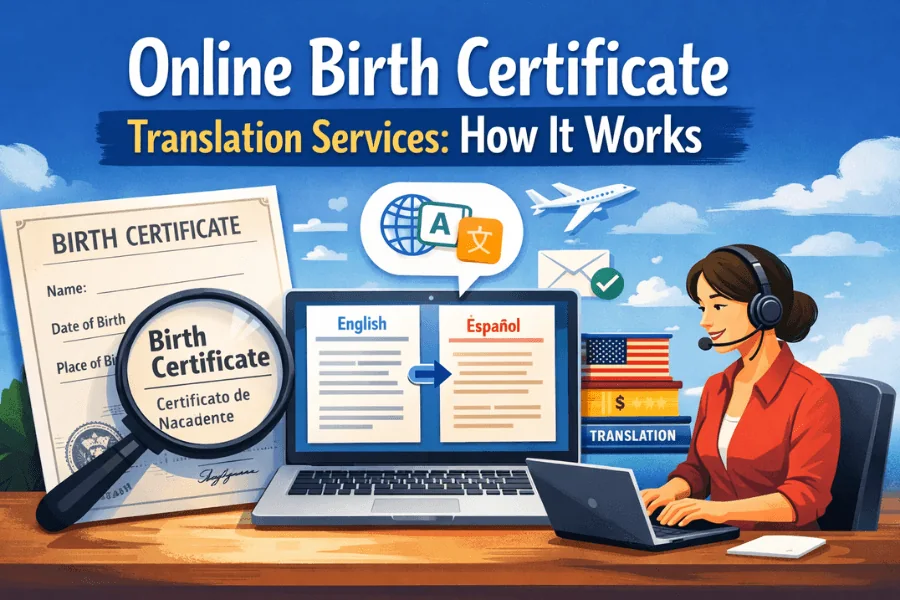
TL;DR: Getting a birth certificate translated online takes 5 steps. Upload your document, choose certified or certified plus notarized, get a quote, and receive your translation from a human translator. Most orders finish in 24 to 48 hours.
If you are applying for a Green Card, visa, or U.S. citizenship, getting your online birth certificate translation right is the difference between approval and a costly Request for Evidence (RFE). A flipped date, a missing stamp, or a name spelled incorrectly can stall an otherwise solid application, and these mistakes happen often enough that immigration offices flag translation issues thousands of times a year.
This guide focuses specifically on how the online ordering process works, from upload to delivery. For the full picture of translating a birth certificate end to end, including formatting rules and country-specific standards, see our guide on how to translate a birth certificate to English.
How to Get a Proper Online Certified Birth Certificate Translation
- Upload your original. Scan or photo your foreign birth certificate, the full thing, stamps, seals, and handwritten notes included.
- Professional translation. A qualified translator recreates it word-for-word in English. Nothing summarized, nothing skipped, including the original layout so it can be compared side-by-side with the source.
- Certification. The translator adds a signed statement confirming completeness and accuracy. No DIY, no family favors, it has to be a neutral professional.
- You get the package. Usually a PDF with the original scan, the full English version, and the certification attached, ready to submit alongside your forms.
Skip the free machine-translation shortcuts. They almost always backfire. A properly certified service gets it right the first time and keeps your application moving.
What Is an Online Birth Certificate Translation Service?
An online birth certificate translation service is a digital offering that lets you submit your foreign birth record and receive a professional, certified translation in English, with the finished documents delivered electronically. Additional options typically include notarization, apostille guidance, and rush delivery.
The main advantage is speed and convenience, but the key is compliance: the translation must meet the legal standards of the specific receiving authority (USCIS, a court, a university, an embassy). Speed without compliance just gets you a fast rejection instead of a slow one.
What You’ll Need Before You Start
Having these ready before you upload speeds up every step that follows:
- A clear scan or photo of the full original document, front and back if there’s anything on the reverse side.
- The exact spelling of names as they appear on your passport or government ID, in case it differs from the birth certificate.
- The name of the receiving authority (USCIS, a specific court, a specific university), since that determines whether you need certification only or certification plus notarization.
- A way to pay online, since most providers require payment before assigning a translator.
- A rough sense of your deadline, so you know upfront whether standard turnaround works or you need to pay for rush service.
Step-by-Step: How the Online Birth Certificate Translation Process Works
Here’s the typical workflow used by online providers:
- Step 1: Upload original. PDF, JPG, or PNG. Include the full original, all pages, stamps, and handwritten notes.
- Step 2: Select service level. Certified, certified plus notarized, rush, or apostille assistance. Country of origin matters, since language variants differ.
- Step 3: Quote and payment. A quote based on language, length, and rush needs, paid securely online through a standard processor. Most providers require payment upfront before a translator is assigned, so have your payment method ready alongside your documents.
- Step 4: Assignment to a specialist. Your file goes to a translator experienced in legal and immigration documents. Rare languages get a vetted specialist, since not every provider keeps in-house translators for every language pair on staff, and a rare-language order may take a bit longer for exactly this reason.
- Step 5: Human translation plus QC. A verbatim translation, ideally with a second review by an editor who checks the translation against the original line by line, confirms every stamp and note was captured, and verifies the certification statement is complete before it goes out.
- Step 6: Certification. The translator adds a signed statement with name, signature, date, and contact information, confirming completeness, accuracy, and competence in both languages.
- Step 7: Optional notarization. If requested, a notary public verifies the translator’s signature and adds a notarial seal, in person or via Remote Online Notarization (RON) where legal.
- Step 8: Delivery. You receive the certified translation, a scanned copy of the original, the certification affidavit, and a notarized page if requested.
- Step 9: Post-delivery support. The provider answers questions and makes adjustments if the receiving authority asks for clarification.
Is It Safe to Upload Your Birth Certificate Online?
A birth certificate carries sensitive personal information, so it’s a fair question before you upload anything.
- Encryption: a reputable service encrypts your file both in transit (while uploading) and at rest (while stored on their servers), not just one or the other.
- Access: only the assigned translator and a reviewing editor should be able to open your file, not the whole company.
- Retention: ask how long your file is kept after delivery and whether you can request deletion once you no longer need it on file.
- Payment security: payment should run through a standard secure processor, not a direct bank transfer or an unencrypted form, the same baseline you’d expect from any online purchase involving personal documents.
- How this differs from mailing: a mailed physical document can be lost, delayed, or intercepted with no record of where it went. A properly encrypted digital upload leaves an audit trail and never leaves a verifiable chain of custody.
Read the provider’s privacy policy and terms and conditions before uploading an identity document to any service, this one included.
The Regulatory Basics
The requirement itself hasn’t changed heading into 2026. Per federal regulation, as explained by the Murthy Law Firm, “any document containing foreign language submitted to USCIS shall be accompanied by a full English language translation which the translator has certified as complete and accurate, and by the translator’s certification that he or she is competent to translate from the foreign language into English.” This is the text of 8 CFR 103.2(b)(3) itself, not just one firm’s interpretation of it.
There is no requirement that a specific official translation service be used. What matters is that a qualified, neutral translator provides the certification, not that you paid a government agency for it.
A typical certification statement looks something like this:
“I, [translator’s name], certify that I am fluent in both [source language] and English, and that the foregoing is a complete and accurate translation of the attached document to the best of my knowledge and ability.”
Signature: ______________________
Name: ______________________
Date: ______________________
Contact information: ______________________
The exact wording can vary slightly between providers, but a name, a signature, a date, and contact information are the four elements every valid certification needs, and their absence is the single most common reason a translation gets sent back.
Certification vs. Notarization, in Brief
USCIS requires a certified translation: a complete English version plus the translator’s signed statement of accuracy and competence. It does not require notarization. A notary only confirms the identity of the person signing, not the accuracy of the translation itself.
Notarization is sometimes requested by courts, embassies, or foreign authorities instead of, or in addition to, certification. For the full comparison and when each one applies, see our certified vs. notarized translation guide, and for a deeper look at exactly what makes a translation certified in the first place, see our guide on what makes a birth certificate translation certified.
Formatting Requirements at a Glance
- English translation mirrors the original: same order, same fields.
- Stamps and handwriting are translated or marked, e.g. “[handwritten: Corrected].”
- Dates keep their original format or are clarified, e.g. “03/04/1990, day/month/year.”
- Multi-page documents are numbered, “Page X of Y.”
- The certification appears on the last page or as a separate attached affidavit.
- Fonts stay clear and readable, and any table structure in the original is preserved rather than collapsed into plain paragraphs.
Mirroring the layout isn’t just cosmetic. It’s what lets an immigration officer or admissions reviewer compare the translation against the original line by line without hunting for where a given field went.
Common Mistakes, in Brief
These four account for most rejections and RFEs tied to translation:
- Missing certification statement. The translation itself can be perfect and still get rejected without it.
- Incomplete translation. Skipped stamps, seals, or handwritten notes create an incomplete record.
- Name mismatch. Spelling that doesn’t match your passport, even by one letter, raises a flag.
- Machine translation. Automated tools miss legal and administrative terminology often enough that immigration officers can usually tell.
For a full breakdown of each mistake and how to avoid it, see our guide on why certified translations get rejected.
Country-Specific Formatting Differences
Requirements vary by destination, not just by translator quality:
| Country | Required Format | Certification Needed? |
|---|---|---|
| Australia | Line-by-line bilingual | Yes (NAATI-certified) |
| USA (USCIS) | Word-for-word | Yes (signed and dated) |
| Canada | Paragraph or line-by-line | Yes (certified or affidavit) |
| United Kingdom | Paragraph acceptable | Yes (professional statement) |
These standards change over time. For current, country-by-country legal requirements, see our legal requirements guide.
Turnaround Times and Rush Options
Standard turnaround is 24 to 48 hours for most language pairs. Less common language pairs can run up to 72 hours. Rush service, when available, typically runs 6 to 24 hours for an added fee, and same-day delivery is sometimes possible for short documents in common languages.
Speed depends on language rarity, the quality of your original scan, whether notarization is requested (in-person notarization adds time), and time zone differences with your assigned translator.
Pricing Factors
Cost depends on the language pair (common pairs cost less than rare ones), document complexity (stamps, seals, and handwritten notes add cost), length, turnaround speed (rush service often adds 50 to 100%), and whether notarization or apostille assistance is requested. Always ask for a quote that breaks these out separately.
As a worked example: a standard single-page birth certificate in a common language pair typically runs $22.99 to $60 for certified translation alone. Adding notarization is usually a small fixed add-on fee. Rush delivery adds a percentage on top of the base price rather than a flat fee, so a rushed rare-language document costs more than a rushed common one.
Digital vs. Physical Copies
Most U.S. authorities, including USCIS, accept a printed copy of a digital certified translation submitted with your application. You don’t need an original mailed document for a standard USCIS filing.
Some foreign consulates are the exception: a few still require an original mailed hard copy rather than a printed PDF. If your destination is a consulate rather than USCIS, confirm this before you order, since a rush digital delivery won’t help if the receiving office insists on the original in the mail. When in doubt, a quick email to the consulate before you order saves a possible second round of mailing later.
Document-Specific Guidance
Birth certificate translation is the most fundamental identity document for nearly any USCIS process. A correct translation is complete, word-for-word, and mirrors the original layout so an officer can compare the two side by side.
Marriage certificates and academic transcripts follow the same certification principle but have their own specific requirements. See our marriage certificate translation guide and our academic transcript translation guide, the latter including whether you’ll also need a credential evaluation from a service like WES or ECE. If you’re specifically navigating a WES evaluation, our WES certified translation guide covers the exact documentation rules.
Online vs. In-Person: Quick Comparison
| Feature | Online Service | In-Person Local Service |
|---|---|---|
| Speed | 24 to 48 hours typical, rush available | Varies, often slower |
| Convenience | Upload from anywhere | Must travel or mail documents |
| Quality control | Translator plus editor review standard | Varies by provider |
| Notarization | Offered in-house or via partner | Usually available locally |
| Records | Digital records kept | Often paper-based |
Why DIY Translation Fails
Even a perfect self-translation is invalid for official use, because authorities require the translator to be a neutral third party, not the applicant or a family member. The same logic applies to AI tools, see our guide on why professional translation beats AI tools for the full comparison. Two things drive this rule:
- Professional accountability. Authorities want someone external and traceable taking responsibility for the accuracy of the translation. A self-made translation has no one else to hold accountable if something is wrong.
- Avoiding bias. Many jurisdictions simply don’t consider an applicant impartial about their own document, even when the translation itself is accurate. That alone is enough to invalidate it.
Beyond the certification issue, DIY translations commonly miss required elements too: an official layout, an abbreviation, a stamp, or a marginal note, any of which can trigger a rejection or an RFE on its own.
What to Do If You Get an RFE for Your Translation
If USCIS issues a Request for Evidence over a translation, don’t just resubmit the same document as-is. Work through it in order:
- Read the RFE notice carefully. USCIS usually names the specific defect, missing certification, an incomplete section, a formatting problem, rather than leaving you guessing.
- Check the certification statement first. A missing or incomplete certification is the single most common cause, and it’s the fastest thing to fix.
- Compare every stamp and handwritten note against the original. A skipped seal or marginal note is the second most common cause.
- Confirm the name spelling matches your passport exactly. Even a one-letter difference can be flagged.
Most translation-related RFEs trace back to one of these three issues. Fixing the specific one named in the notice is faster and cheaper than re-ordering the whole translation from scratch.
Best Practices Before You Submit
- Original document copy included
- Full English translation included
- Certification statement included and signed
- Names match across all documents
- Dates are accurate and unambiguous
- Stamps, seals, and notes are translated or described
- All pages, front and back, are accounted for
This check takes two minutes and can save weeks of waiting on a resubmission.
When You’ll Need More Than Just a Translation
A certified translation is the baseline, but some situations call for extra steps on top of it:
- Notarization if a court, embassy, or foreign authority specifically asks for it, not USCIS by default.
- Apostille if the receiving country is a Hague Convention member and the underlying document, not just the translation, needs authentication for use abroad.
- A credential evaluation from a service like WES or ECE if you’re submitting an academic document rather than a birth certificate, since universities and licensing boards often want a U.S.-equivalency report alongside the translation itself.
Ask upfront which of these apply to your situation, since ordering them together with your translation is usually faster than adding them after the fact.
How to Choose a Provider
Not all online providers are equal, and a low price sometimes means something was cut from the process. Before ordering, check for:
- A human translator, not just machine output. Ask directly if you’re unsure; a reputable provider will confirm this without hesitation.
- A second review step. An editor checking the translator’s work catches errors a single pass can miss.
- Transparent, itemized pricing. You should be able to see the base translation cost separately from notarization, rush fees, and apostille assistance, not one bundled number.
- A sample certification statement available on request. If a provider can’t show you what their certification looks like before you order, that’s worth asking about.
Frequently Asked Questions
Online birth certificate translation is simple and fully compliant when handled by a professional: upload, get certified, submit. The details that matter are accuracy, proper certification, correct formatting, and knowing whether notarization or an apostille applies to your specific case. Getting each of those right the first time is what keeps a routine document from turning into a months-long delay.
Order Your Translation Now & Get These
Features IN THE SAME PLACE:


Reviewed by Verena Gale - Certified Court Translator: German, Slovene, English