TL;DR: A Certificate of Accuracy is the signed statement that turns a plain translation into a certified one, confirming completeness, accuracy, and the translator’s competence. A missing signature is the most common reason one gets rejected.
A Certificate of Accuracy is the specific document that turns an ordinary translation into a certified one. If you have read our broader guide on what a certified translation is, you have already seen this term mentioned in passing. This guide narrows in on the certificate itself: what it says, what it needs to include, why immigration authorities rely on it specifically, and what actually goes wrong when one gets rejected.
Certificate of Accuracy Defined
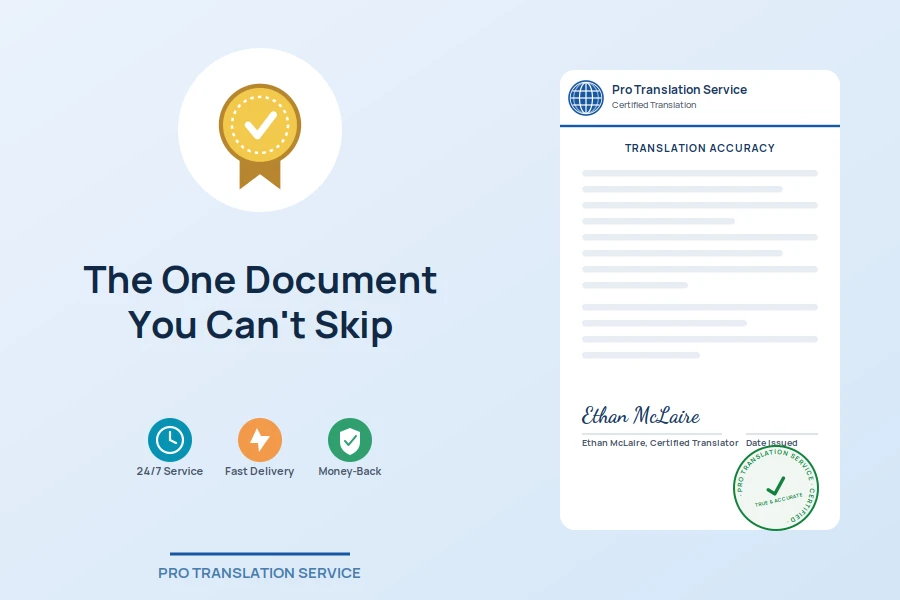
A Certificate of Accuracy is a signed statement, prepared by the translator or by a translation company on the translator’s behalf, formally declaring that a translated document is complete and accurate, and that the translator is competent to translate between the two languages involved. It is usually presented as its own page, physically attached to or accompanying the translated document, rather than embedded as a stamp or footnote within the translation’s body text.
This certificate is the specific mechanism that satisfies the legal requirement behind the term “certified translation.” Without it, a translation is just a translation: potentially accurate, but without the formal, signed declaration that USCIS, UKVI, and IRCC all rely on to accept it as evidence. This is worth sitting with for a moment, because it means the certificate itself, not the translator’s underlying skill, is the specific thing a reviewing officer is trained to check for first.
What Information a Certificate of Accuracy Includes
A properly prepared certificate consistently includes a handful of specific elements, regardless of which provider prepares it. It states clearly that the translation is a complete and accurate representation of the original document. It states that the translator is competent in both the source language and English. It includes the translator’s full name and an actual signature, not a typed name in its place, since a typed name is treated as equivalent to a missing signature. It is dated, reflecting when the translation was actually completed. And it includes contact information for the translator or translation company, typically an address, phone number, or email, so the certificate can be independently verified if a question arises during the review process.
For UKVI submissions specifically, Immigration Rules paragraph 39B requires this same set of elements explicitly, and adds one more requirement for leave to remain and indefinite leave to remain applications specifically: the translator’s relevant credentials also need to appear on the certificate for those particular categories.
IRCC’s version of this document works a little differently, and it is worth understanding the distinction clearly rather than assuming it works the same way. If the translator is a member of a recognized Canadian provincial or territorial translators’ association, their stamped, signed statement functions the same way a Certificate of Accuracy does for USCIS or UKVI purposes. If the translator does not hold that specific credential, their certificate needs to be accompanied by a separate sworn affidavit, adding a step that neither USCIS nor UKVI requires under any circumstances. Our complete guide to IRCC’s translation standard covers this two-path system in full.
An Example of What the Wording Looks Like
There is no universal template, but a compliant Certificate of Accuracy typically reads something close to this: a statement that the translator certifies they are fluent in both the source language and English, that the attached translation is a true, complete, and accurate rendering of the specific original document to the best of their knowledge and ability, followed by the translator’s printed name, signature, the date, and their contact information. The exact sentence structure varies between providers, and that variation is entirely normal. What has to stay constant is the substance behind it: a clear statement of completeness, accuracy, and competence, tied to a real, verifiable person.
Why Immigration Authorities Require It
The certificate exists to answer a specific question a reviewing officer cannot otherwise verify on their own: is this translation actually accurate, and who is accountable for it if a question comes up later. USCIS’s governing regulation, 8 CFR 103.2(b)(3), builds this accountability directly into the requirement itself, and the USCIS Policy Manual treats the certificate as the actual evidence of translation quality that officers are trained to look for, rather than independently evaluating the linguistic accuracy of every translated document that comes through their queue.
This is also why the certificate’s completeness matters as much as the translation’s own accuracy. A perfectly accurate translation with an incomplete certificate, missing a signature or a competence declaration, does not satisfy the requirement, because the certificate itself is the formal mechanism the regulation is built around, not simply a courtesy attached to good work.
Certificate of Accuracy vs. Notarization
These two get confused constantly, and the distinction is worth restating clearly here. A Certificate of Accuracy is the translator’s own declaration of the translation’s accuracy and their competence to produce it. Notarization is a separate, additional service in which a notary public verifies the identity of the person signing a document, without evaluating the content or accuracy of what was signed at all, since a notary typically has no way to assess a translation’s linguistic quality. USCIS and UKVI both accept a Certificate of Accuracy on its own, without notarization, for standard filings. Our guide on notarized vs. certified vs. sworn translation covers this distinction in much greater depth, including why the confusion between the two is so persistent across nearly every document type we translate.
Common Errors That Make a Certificate Incomplete
A handful of specific mistakes account for most Certificate of Accuracy problems, and knowing them in advance makes it easy to check your own translation before submitting it to any authority. A typed name in place of an actual signature is the most common issue, and it is treated as a missing signature entirely, not a minor formatting choice that a caseworker might overlook. A certification statement that references the wrong document, for example leftover language from a template that was not properly updated for the specific certificate it appears on, is another recurring problem, since it creates a direct mismatch between what the certificate claims to cover and what was actually translated. Missing contact information, or contact information that cannot actually be verified, such as a disconnected phone number or an address that does not correspond to a real business location, undermines the entire point of the certificate, which exists specifically so a reviewing authority can confirm the translator is real, reachable, and accountable for the work they signed off on.
A certificate that covers only part of a multi-page document is a more subtle version of the same problem. If a document runs several pages, the certification needs to make clear that it covers the complete translation, not just the page it happens to be attached to, since an authority reviewing a partial certification may reasonably wonder whether the rest of the document was translated at all.
Certificate of Accuracy vs. a Sworn Translator’s Certification
It is worth drawing one more distinction here, since it connects to a different system entirely and comes up often enough to be worth addressing directly. A Certificate of Accuracy is the mechanism used under the certified translation model that USCIS, UKVI, and IRCC all rely on for their own purposes. Civil-law countries like France, Germany, Italy, and Spain use a different mechanism altogether: a sworn translator’s own official stamp and signature, tied to a government appointment rather than a self-prepared certification statement written by the translator themselves. A Certificate of Accuracy does not carry legal weight inside these countries’ own court or government systems the way a sworn translator’s stamp does, and the reverse is also true: a sworn translator’s stamp is not what USCIS, UKVI, or IRCC are looking for either. Our guide on notarized vs. certified vs. sworn translation covers this broader distinction in full, including how each system actually works.
What Our Certificate of Accuracy Looks Like
Every certified translation we provide includes a signed Certificate of Accuracy meeting every element covered above: a clear statement of completeness and accuracy, a statement of the translator’s competence, a genuine signature, the date, and full contact information. For UKVI-bound filings requiring translator credentials specifically, those are included as well.
If you are earlier in the process and want the broader context of what a certified translation package includes beyond just the certificate itself, our beginner’s guide covers that ground. And if your question is really about who is legally permitted to sign this kind of certificate in the first place, our guide on who can legally certify a translation addresses that directly, since the answer is broader than most people expect.
You can order your certified translation and receive a properly prepared Certificate of Accuracy with every document, meeting every element covered throughout this guide. You can also place your order directly once you are ready to submit your documents.
Whether you are ordering your first certified translation or reviewing one you already received, the certificate itself is worth understanding on its own terms, separate from the translation it accompanies. It is a small document that carries real legal weight, and knowing what it needs to say, and what commonly goes wrong when it falls short, is genuinely useful knowledge whether you are the one signing it or the one relying on someone else’s signature.
Frequently Asked Questions
Order Your Translation Now & Get These
Features IN THE SAME PLACE:


Reviewed by Almu Jiménez - Spanish Localisation Expert