
Certified translations are often required for some of the most important moments in life: immigration applications, court cases, academic admissions, business contracts, and government filings. Yet every year, thousands of applications are delayed or outright rejected because of translation issues that could have been easily avoided.
If you have ever wondered why a certified translation gets rejected even after paying for it, you are not alone. The problem is rarely the document itself. In most cases, it is the way the translation was prepared, certified, or submitted
In this in-depth guide, we will explain exactly why certified translations get rejected, how authorities like USCIS, courts, universities, and embassies evaluate translations, and most importantly, how you can avoid costly mistakes by choosing the right translation service.
What Is a Certified Translation?
A certified translation is a translated document accompanied by a signed statement from the translator or translation company confirming that:
- The translation is complete and accurate
- The translator is competent in both languages
- The translation faithfully reflects the original document
In the United States, certified translations are commonly required by:
- USCIS (U.S. Citizenship and Immigration Services)
- Courts and legal institutions
- Universities and credential evaluation agencies
- Government agencies
- Employers and licensing boards
A certified translation is not the same as a notarized translation, a distinction that causes many rejections.
The Most Common Reasons Certified Translations Get Rejected
Let’s break down the real reasons translations fail approval, starting with the most frequent and damaging mistakes.
1. Missing or Incorrect Certification Statement
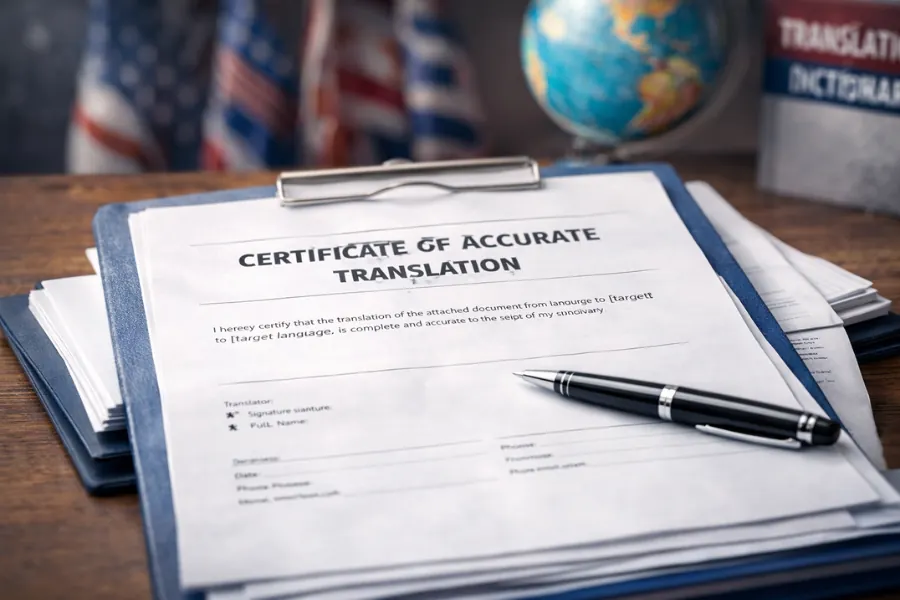
This is the number one reason certified translations are rejected. Many people assume that a translation alone is enough. It is not. Authorities require a formal certification statement that includes:
- A declaration of accuracy and completeness
- The translator’s full name
- Signature
- Date
- Contact information
Common mistakes include:
- Using generic or incomplete certification language
- Forgetting the signature
- Submitting an unsigned PDF
- Using outdated certification formats
USCIS is very strict. Even a small omission can result in a Request for Evidence (RFE) or denial.
How to avoid it:
Always use a professional translation service that provides USCIS-compliant certification wording, included with every certified translation.
2. Confusing Certified Translation With Notarized Translation
This confusion leads to thousands of rejections every year.
- A certified translation verifies accuracy
- A notarized translation verifies the identity of the signer
Notarization does not replace certification unless explicitly required by the receiving authority.
Many clients submit:
- A notarized document without certification
- A certified translation when notarization was required
- A document notarized in the wrong country
How to avoid it:
Always confirm whether you need:
At ProTranslationService.com, we clearly explain the difference and provide both certified and notarized translations when required.
- Certified translation only
- Certified + notarized translation
- Apostille (for international use)
3. Incomplete Translation of the Original Document
Authorities require complete translations, not summaries.
What often gets skipped:
- Stamps and seals
- Handwritten notes
- Marginal text
- Headers, footers, and annotations
Even a single missing stamp can invalidate the translation. USCIS and courts expect statements like:
“Stamp: Ministry of Interior, dated March 14, 2022”
How to avoid it:
Never translate documents yourself or use automated tools. Professional translators are trained to identify and translate every visible element.
4. Poor Translation Quality or Errors
Even certified translations can be rejected if the content is inaccurate.
Common quality issues:
- Incorrect names or spellings
- Wrong dates or number formats
- Mistranslated legal or medical terms
- Inconsistent terminology
For example:
- “Single” translated as “unmarried” when the original indicates “divorced”
- Date formats switched between MM/DD/YYYY and DD/MM/YYYY
These errors raise red flags and can trigger additional scrutiny.
How to avoid it:
Use experienced, human translators with subject-matter expertise, especially for legal, immigration, and academic documents.
5. Using Machine Translation or AI Tools
This is becoming a growing problem.
Tools like Google Translate or AI-generated translations may appear accurate, but they:
- Miss context
- Misinterpret legal language
- Fail to meet certification requirements
- Are not accepted by USCIS or courts
Authorities can easily identify machine-generated translations by their unnatural phrasing and formatting inconsistencies.
How to avoid it:
Only submit translations completed and reviewed by qualified human translators. AI can assist professionals, but it cannot replace certification or accountability.
6. Formatting That Does Not Match the Original Document
Formatting matters more than most people realize.
Rejections often occur because:
- Tables are removed
- Layout is altered
- Page numbers are missing
- Paragraph structure is changed
Authorities expect the translation to mirror the original document’s structure.
How to avoid it:
Choose a service that preserves layout, formatting, and document structure exactly as required.
7. Wrong Language Pair or Regional Dialect Issues
Some languages have multiple regional variants.
For example:
- Spanish (Spain vs. Latin America)
- Arabic dialects
- Chinese (Simplified vs. Traditional)
Using the wrong variant can lead to confusion or rejection, especially in legal or governmental contexts.
How to avoid it:
Work with professional translators who understand regional language requirements and official terminology.
8. Submitting Expired or Outdated Translations
Some institutions require translations to be:
- Recently issued
- Updated to match revised documents
Submitting an old translation for a newly issued document often leads to rejection.
How to avoid it:
Confirm validity requirements before submission and use rush translation services when deadlines are tight.
9. Missing Page Numbers or Multi-Page Certification Errors
If your document has multiple pages, the certification must clearly apply to all pages.
Mistakes include:
- Certifying only page one
- Missing page references
- Separate files without clear linkage
How to avoid it:
Professional agencies ensure certifications explicitly cover the entire document.
10. Using an Unqualified or Anonymous Translator
USCIS and courts require that the translator be identifiable and competent.
Red flags include:
- No translator name
- No credentials or contact details
- Generic “certified by agency” statements
How to avoid it:
Always use a reputable translation service with transparent certification and accountability.
Certified vs. Notarized Translation: Quick Comparison
| Feature | Certified Translation | Notarized Translation |
| Confirms accuracy | Yes | No |
| Required by USCIS | Yes | Sometimes |
| Requires notary | No | Yes |
| Verifies identity | No | Yes |
How Pro Translation Service Helps You Avoid Rejection
At ProTranslationService.com, our process is designed specifically to prevent rejection and delays.
We offer:
- USCIS-compliant certified translations
- Translations in all languages
- Legal, academic, immigration, and business expertise
- Same-day and rush services
- Human quality assurance checks
- Correct formatting and complete certification
Every translation is reviewed before delivery to ensure it meets the exact requirements of the receiving authority.
Documents Commonly Rejected Without Proper Translation
- Birth certificates
- Marriage certificates
- Divorce decrees
- Passports
- Academic transcripts
- Diplomas
- Court judgments
- Affidavits
- Medical records
- Business contracts
Frequently Asked Questions
Final Thoughts: Avoid Rejection Before It Happens
A rejected certified translation is not just an inconvenience. It can delay visas, legal proceedings, academic admissions, and business operations.
The good news is that almost all rejections are preventable.
By understanding the requirements, avoiding shortcuts, and working with a trusted professional translation service, you can submit your documents with confidence.
If accuracy, compliance, and speed matter to you, ProTranslationService.com is here to help.
Order Your Translation Now & Get These
Features IN THE SAME PLACE: