
Certified Translation Services
What is a Certified Translation?
- USCIS immigration filings
- Court documents
- Academic transcripts
- Medical records
- Business documents


Why Choose Our Certified Translation Services?
- 100% USCIS Acceptance Guarantee
We ensure your certified translations are accepted by USCIS, courts, universities, and other official institutions. - Certified Professional Translators
Our team consists of highly skilled, verified translators who deliver accurate and complete translations. - Quick Turnaround
We deliver your certified translation in as little as 24 hours. Need it sooner? Expedited services are available. - Secure & Confidential
Your documents are handled with strict confidentiality. We use advanced encryption to protect your personal information and files.

What's Included in Every Certified Translation
- Certified Accuracy
Each translation includes a signed certification statement confirming its accuracy and completeness. - Professional Translation
Our team consists of highly skilled, verified translators who deliver accurate and complete translations. - Fast Delivery
Receive your certified translation with a signed certificate in as little as 24 hours. Expedited options are available. - Digital Delivery
Your certified translation is delivered securely in PDF format. - Free Revisions
We offer free revisions within 7 days to ensure accuracy and completeness.

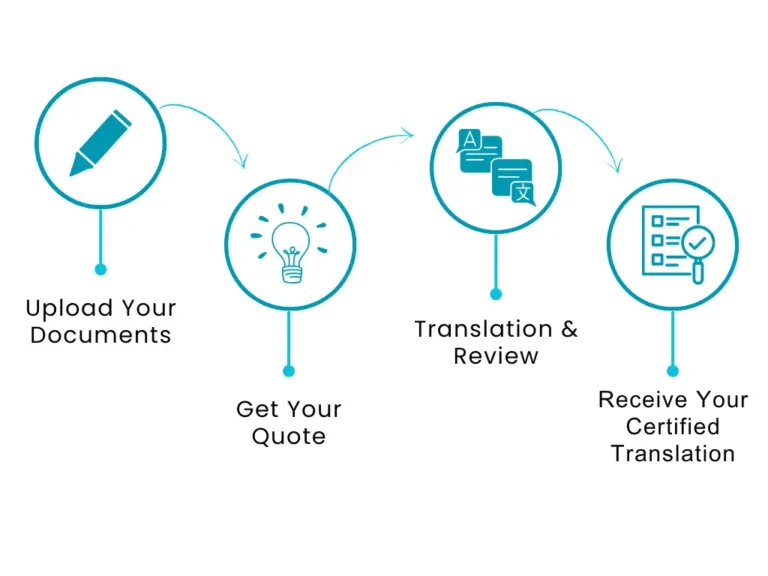
How to Order Your Certified Translation
Pricing for Certified Translation
- Starting at $22.99 per page
- Up to 250 words per page
- Secure payment options


Languages We Translate
- Spanish
- French
- German
- Arabic
- Chinese
- Russian
Popular Document Translations
- Birth certificates
- Transcripts & diplomas
- Marriage certificates
- Medical records
- Business and legal documents

FAQs About Certified Translation
A certified translation is a document translated by a professional translator and accompanied by a signed statement confirming its accuracy and completeness. It is typically required for official use by immigration, legal, and academic institutions.
Certified translation services are commonly required for official documents such as birth certificates, marriage certificates, diplomas, transcripts, and immigration paperwork.
Yes. Our certified translation services meet USCIS requirements and are accepted by U.S. government agencies, courts, and academic institutions.
We offer a standard turnaround of 24 hours, with expedited options available for urgent requests.
Certified translations start at $22.99 per page, with transparent pricing and no hidden fees.
Comprehensive Guide to Certified Translation
What Is a Certified Translation?
A certified translation is a translated document accompanied by a signed statement from the translator confirming that the translation is accurate and complete. This certification gives the document legal credibility and allows it to be used for official purposes. Certified translations are commonly required when submitting foreign-language documents to government agencies, courts, or academic institutions.In the United States, certified translations are frequently requested for immigration processes. For example, the USCIS translation requirements clearly state that any document not in English must be accompanied by a full English translation and a certification of accuracy. Failure to meet these requirements can result in delays or rejection of applications.Legal Requirements by Country
Certified translation requirements are not the same in every country. In the United States, any competent translator can provide a certified translation, as long as they include a signed certification statement. However, many European countries follow stricter rules.For example, in France and Spain, only sworn translators appointed by a court are authorized to provide legally valid translations. In Germany, certified translators must be officially sworn in by a regional court. The United Kingdom often prefers translators affiliated with recognized professional bodies such as the Chartered Institute of Linguists.Because requirements vary, it is important to confirm the exact rules of the receiving authority before submitting your documents. Even small differences in formatting or certification wording can affect acceptance.Key Elements of a Certification Statement
A valid certification statement must clearly confirm that the translation is complete and accurate. It typically includes the translator’s full name, signature, and the date of certification. Some authorities may also require contact details or additional declarations.In certain cases, notarization may be requested. This does not verify the translation itself but confirms the identity of the person signing the certification. Digital certifications are also becoming more common, especially for online submissions, but acceptance depends on the authority reviewing the document.Certified vs. Notarized vs. Sworn Translation
These terms are often confused, but they have different meanings. A certified translation includes a signed statement of accuracy. A notarized translation involves a notary public verifying the identity of the signer. A sworn translation is completed by a translator authorized by a court or government authority.Understanding the difference is important because submitting the wrong type of translation can lead to rejection. For example, USCIS does not require notarization in most cases, but some foreign institutions may specifically request it.When Certified Translations Are Required
Certified translations are required in many formal situations, including:- Immigration applications and visa processing
- Legal proceedings and court submissions
- University admissions and credential evaluations
- Financial, corporate, and compliance documentation
Common Compliance Issues
Many document rejections occur due to simple compliance mistakes. These include missing certification statements, incomplete translations, incorrect formatting, or failure to translate all visible text such as stamps and seals.Another common issue is using automated tools or unqualified translators. Official authorities require human translation to ensure accuracy and accountability. Ensuring full compliance from the beginning helps avoid costly delays and resubmissions.How to Get a Certified Translation?
Obtaining a certified translation involves a structured process designed to ensure accuracy and compliance with official requirements.Steps
- Submit a clear and complete copy of your document.
- Select the correct source and target languages.
- A qualified human translator completes the translation.
- The document undergoes a review process for quality assurance.
- A certification statement is added and signed by the translator.
- The final certified translation is delivered in a secure digital format.
Quality Standards and Guidelines
Professional certified translation services follow recognized quality standards. One widely accepted benchmark is ISO 17100, which defines requirements for translation quality, including translator qualifications, revision processes, and project management.These standards ensure that translations are accurate, consistent, and suitable for official use. A structured workflow with multiple review stages reduces the risk of errors and improves acceptance rates.How Authorities Evaluate Translations
Government agencies and institutions review certified translations based on completeness, accuracy, and proper certification. They expect all text to be translated, including stamps, handwritten notes, and formatting elements.Any missing information or inconsistencies between the original and translated document can lead to rejection. In immigration cases, even minor discrepancies may result in delays or requests for additional evidence.Choosing a Reliable Translation Provider
Selecting the right provider is critical for avoiding issues. A reliable provider should offer:- Experienced translators with subject-matter expertise
- Clear certification statements that meet official requirements
- Quality assurance processes with multiple review stages
- Transparent pricing and turnaround times
- Secure handling of sensitive documents
Common Mistakes to Avoid
Avoid the following mistakes when preparing certified translations:- Submitting incomplete or low-quality scans
- Using machine translation for official documents
- Ignoring formatting requirements from authorities
- Failing to include a proper certification statement
Data Security and Confidentiality
Certified translations often involve sensitive personal or legal information. It is important to work with providers that follow strict data protection practices. Secure file handling, encrypted storage, and controlled access help protect your documents throughout the process.Emerging Trends in Certified Translation
The certified translation industry continues to evolve with digital workflows and secure online delivery. Electronic signatures and digital certification formats are becoming more widely accepted, especially for immigration and academic submissions.While technology improves efficiency, human translators remain essential for ensuring accuracy and compliance. As demand grows, maintaining high standards of quality and data security remains a top priority.Order Your Certified Translation Now
Get your documents professionally translated and certified today. We are here to make sure your translation meets every requirement and arrives on time.