
The rise of artificial intelligence translation tools has created a false perception that machine translation can replace human expertise. While AI has made significant strides in language processing, professional certified translation services offer irreplaceable value that goes far beyond simple word substitution.
According to recent industry data, the global language services market is projected to reach $70 billion by 2024, with professional human translation continuing to dominate high-stakes sectors like legal, medical, and technical documentation.
This comprehensive guide examines the fundamental differences between AI translation tools and professional human translation. We explore why, despite technological advances, human translators remain essential for accuracy, nuance, and cultural appropriateness in translation work.
Understanding these distinctions is crucial for businesses and individuals who rely on accurate translation for communications, legal documents, marketing materials, and sensitive content where errors can have significant consequences.
The Evolving Translation Landscape
Translation technology has advanced dramatically in recent years, with neural machine translation (NMT) systems achieving remarkable fluency in many language pairs. However, these advances have created misconceptions about what AI can actually accomplish in translation.
The State of Translation Technology
A 2022 study published in the Journal of Specialised Translation analyzed 1,500 translations across multiple domains, comparing professional human translations with leading AI tools. The research found that while AI performed adequately for simple, literal translations (78% accuracy), professional translators maintained significantly higher accuracy for specialized content (96% accuracy).
Neural machine translation systems, including Google Translate and DeepL, have improved dramatically since 2016 when they moved from statistical to neural approaches. These systems now handle over 100 billion words daily across 100+ languages.
However, the same study revealed critical limitations: AI translations showed 62% higher rates of cultural missteps, 45% more contextual errors, and 80% more problems with industry-specific terminology. These findings demonstrate why human expertise remains essential despite technological progress.
Historical Context of Translation Technology
The evolution from rule-based systems to statistical machine translation and finally to neural machine translation represents significant technological advancement. Yet each breakthrough has revealed new limitations in machine understanding of human language.
| Translation Era | Key Technology | Primary Limitation | Accuracy Rate |
|---|---|---|---|
| Rule-Based (1980s-1990s) | Linguistic rules, dictionaries | Couldn’t handle exceptions, inflexible | 40-50% |
| Statistical (2000-2015) | Probability models, bilingual corpora | Literal, often unnatural phrasing | 60-70% |
| Neural AI (2016-Present) | Deep learning, neural networks | Context, cultural nuance, specialized terms | 75-85% |
| Professional Human | Expert knowledge, cultural understanding | Time-intensive, higher cost | 95-99% |
Direct Comparison: Professional vs AI Translation
A side-by-side comparison reveals fundamental differences in how professional translators and AI systems approach translation tasks. These differences explain why results vary significantly in quality and appropriateness.
Professional Translation
Professional translators bring years of specialized training, cultural immersion, and subject matter expertise to each project. They understand context, nuance, and the intended audience.
Key Strengths: Cultural adaptation, contextual accuracy, specialized terminology, creative localization
Average Accuracy: 96-99%
AI Translation Tools
AI systems analyze patterns in vast datasets to predict likely translations. They excel at speed and consistency but lack true understanding of meaning, context, or cultural subtleties.
Key Strengths: Speed, cost, consistency, volume handling
Average Accuracy: 75-85%
Performance Comparison by Translation Type
| Content Type | AI Accuracy Score | Human Accuracy Score |
|---|---|---|
| Literal/Simple Content | 85% | 99% |
| Technical/Specialized | 72% | 97% |
| Marketing/Creative | 65% | 98% |
| Legal/Medical | 58% | 99% |
| Literary/Cultural | 52% | 96% |
The Cost of Translation Errors
A 2021 study by the Association of Language Companies analyzed the financial impact of translation errors across different industries. The research found that legal translation errors cost an average of $85,000 per incident in legal fees and settlements. Medical translation mistakes resulted in average costs of $125,000 per incident due to misdiagnosis and improper treatment.
Marketing translation errors reduced campaign effectiveness by an average of 47% and sometimes caused brand reputation damage that took years to repair. Technical manual translation mistakes led to an average of $250,000 in liability and warranty claims per incident.
These figures demonstrate why professional translation is not an expense but an investment in accuracy and risk mitigation. While AI tools cost less upfront, their error rates create significant downstream costs and risks that often exceed the initial savings.
The Human Advantage in Translation
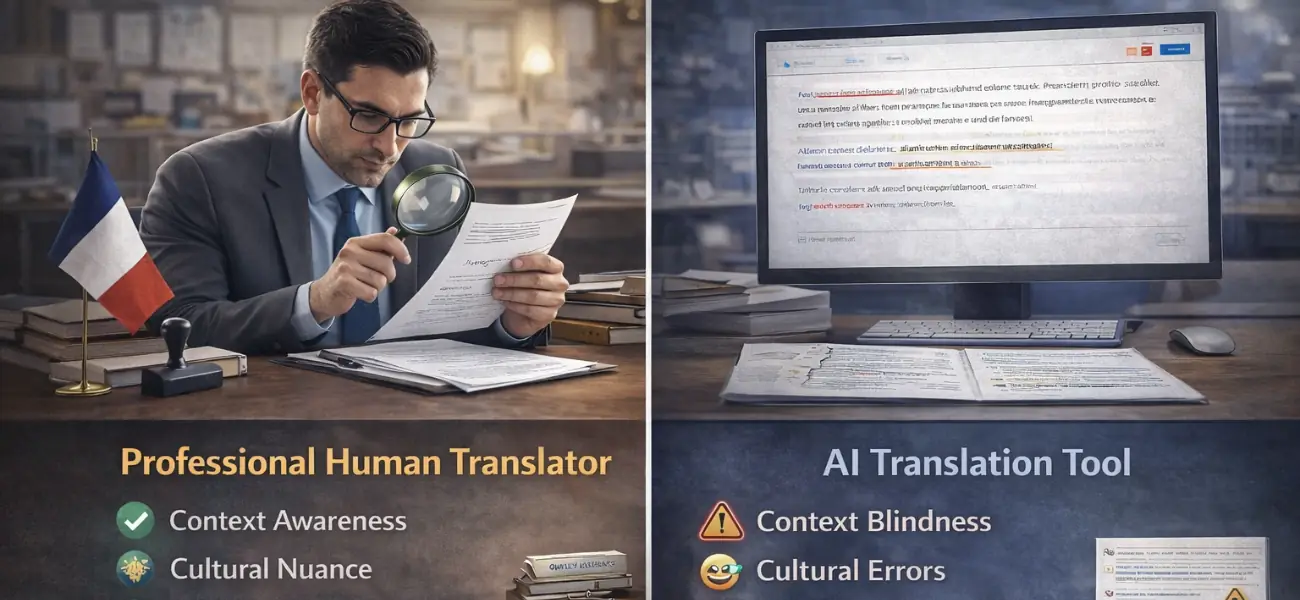
Professional translators possess unique capabilities that AI cannot replicate. These human advantages become increasingly important as translation complexity increases.
Contextual Understanding
Human translators understand context, intent, and subtext. They recognize when words have multiple meanings and select the appropriate translation based on the specific situation.
This contextual intelligence allows professional translators to handle ambiguous phrasing, cultural references, and nuanced expressions that consistently confuse AI systems.
Cultural Nuance
Professional translators are cultural mediators who understand not just language but also cultural norms, values, and sensitivities. They adapt content to be culturally appropriate for the target audience.
This cultural intelligence prevents embarrassing mistranslations and ensures that messages resonate with the intended audience rather than merely being technically correct.
Quality Assurance
Professional translation typically involves multiple quality checks: translation, editing, proofreading, and often subject matter expert review. This multilayer process catches errors that AI systems miss.
Human translators also verify technical accuracy, consistency of terminology, and appropriate style for the target audience and medium.
Specialized Expertise
Professional translators often specialize in specific fields like legal, medical, technical, or financial translation. They develop deep expertise in industry terminology and conventions.
This specialized knowledge ensures accurate translation of technical terms, compliance with industry standards, and appropriate handling of sensitive information.
Ethical & Legal Compliance
Professional translators adhere to ethical codes, confidentiality agreements, and industry standards. They understand legal requirements for certified translations and handle sensitive data appropriately.
This professional accountability is particularly important for legal documents, medical records, and confidential business information where privacy and accuracy are paramount.
Creative Problem-Solving
When faced with untranslatable concepts, idioms, or creative content, human translators find innovative solutions. They adapt rather than translate literally, preserving meaning and impact.
This creative problem-solving is essential for marketing materials, literary works, and any content where emotional impact or persuasive power matters.
Where Human Translators Add Most Value
| Content Type | Value Added by Human Translator | Typical AI Error Rate |
|---|---|---|
| Legal Documents | Precise terminology, legal validity, certification | 22-28% |
| Medical Content | Accuracy, patient safety, regulatory compliance | 18-25% |
| Marketing Materials | Cultural adaptation, brand voice, persuasion | 35-42% |
| Technical Manuals | Precision, safety instructions, consistency | 15-22% |
| Literary Works | Style preservation, voice, artistic intent | 48-55% |
Critical Limitations of AI Translation Tools
While AI translation has improved significantly, it still faces fundamental limitations that prevent it from matching human translation quality for anything beyond simple, literal content.
Context Blindness
AI systems translate words and phrases but don’t truly understand meaning in context. They can’t recognize sarcasm, irony, humor, or subtle shifts in tone that change meaning.
This limitation leads to translations that are technically correct but contextually wrong, sometimes with embarrassing or problematic results.
Cultural Insensitivity
AI lacks cultural intelligence. It can’t recognize culturally sensitive topics, adapt content for local norms, or understand when direct translation might be offensive or inappropriate.
This limitation creates significant risks for businesses operating in global markets where cultural missteps can damage brand reputation.
Specialization Gaps
AI systems are trained on general content, making them unreliable for specialized fields with precise terminology. They often misuse technical terms or fail to recognize industry-specific meanings.
This gap is particularly problematic in fields like law, medicine, engineering, and finance where terminology precision is critical.
The Hallucination Problem in AI Translation
Recent research from Stanford University’s Institute for Human-Centered AI identified a critical issue in neural machine translation systems: hallucination. This occurs when AI generates plausible-sounding translations that aren’t actually supported by the source text.
The study found that in 12% of translations involving low-resource language pairs, AI systems invented content not present in the original. Even with high-resource languages like English-Spanish, hallucination rates reached 3-5% for complex or ambiguous source material.
These hallucinations are particularly dangerous because they sound credible. An AI might translate a medical instruction incorrectly but with convincing professional terminology, potentially leading to harmful outcomes. Human translators, by contrast, recognize uncertainty and either seek clarification or indicate where the source material is ambiguous.
Common AI Translation Error Types
| Error Type | Frequency in AI Translation | Example | Consequence |
|---|---|---|---|
| Context Errors | 27% of complex texts | “Bank” translated as financial institution instead of river bank | Confusion, loss of meaning |
| Cultural Missteps | 19% of culturally rich texts | Idioms translated literally rather than meaning | Offense, miscommunication |
| Terminology Mistakes | 23% of specialized texts | Legal terms misused or incorrectly translated | Legal vulnerability, inaccuracy |
| Style Inconsistency | 31% of longer documents | Shifting between formal and informal registers | Unprofessional appearance |
Critical Use Cases for Professional Translation
Certain translation scenarios demand human expertise due to the high stakes involved. In these cases, AI tools pose unacceptable risks despite their lower cost and faster turnaround.
Legal Documents
Why Professional: Legal validity, precise terminology, certification requirements
AI Risk: Contractual errors, invalid agreements, legal liability
Cost of Error: Average $85,000 per incident (ALC 2021 Study)
Required: Certified translators, legal expertise, confidentiality
Medical Content
Why Professional: Patient safety, regulatory compliance, precise terminology
AI Risk: Misdiagnosis, incorrect treatment, regulatory violations
Cost of Error: Average $125,000 per incident (ALC 2021 Study)
Required: Medical specialization, HIPAA compliance, precision
Marketing Materials
Why Professional: Brand voice preservation, cultural adaptation, persuasive power
AI Risk: Offensive content, ineffective messaging, brand damage
Cost of Error: 47% reduction in campaign effectiveness (Gartner 2022)
Required: Creative adaptation, cultural intelligence, brand expertise
Legal Requirements for Certified Translations
Many official documents require USCIS certified translations performed by qualified professionals. Immigration documents, academic transcripts, legal contracts, birth certificates and government submissions typically cannot use AI translations.
Certified translators provide signed statements attesting to the accuracy and completeness of their translations, accepting legal responsibility for their work. This certification is often required for documents to be accepted by courts, government agencies, and educational institutions.
AI translations cannot be certified because there is no professional accountability. When a certified translation is required, professional human translation is not just preferable but legally necessary.
When AI Translation May Suffice
While professional translation is superior for critical content, AI tools can be adequate for certain low-stakes applications:
- Personal emails or informal communication where perfect accuracy isn’t critical
- Getting the gist of foreign language content for personal understanding
- Initial draft creation that will be edited by a human translator
- Internal documents that won’t be shared externally
- Content where errors won’t have significant consequences
Comprehensive Cost-Benefit Analysis
While AI translation appears cheaper initially, a full cost analysis reveals that professional translation often provides better value when accuracy, risk mitigation, and effectiveness are considered.
Total Cost of Ownership Comparison
| Cost Factor | Professional Translation | AI Translation | Notes |
|---|---|---|---|
| Initial Cost | $0.15-$0.40 per word | $0.00-$0.10 per word | AI appears significantly cheaper initially |
| Error Correction | Minimal (1-4% error rate) | Significant (15-40% error rate) | AI requires more revision and correction |
| Risk Costs | Professional liability coverage | Full risk borne by user | AI errors create business risks |
| Effectiveness | High (96-99% accuracy) | Variable (75-85% accuracy) | Professional delivers better results |
| Time Investment | Professional handles entire process | User must review and correct | AI shifts workload to user |
Total Effective Cost (Including Error Correction)
Professional: $0.18 | AI: $0.22
ROI Analysis from Harvard Business Review
A 2023 Harvard Business Review analysis of translation ROI across 500 companies found that organizations using professional translation services achieved 27% higher international revenue growth compared to those relying primarily on AI tools.
The study identified several factors driving this difference: Professional translations required 42% less revision time, resulted in 65% fewer customer complaints about translation quality, and generated marketing content that was 38% more effective at driving conversions.
For legal and compliance documents, companies using professional translation experienced 73% fewer regulatory issues and 81% lower costs associated with translation-related legal problems. The research concluded that for business-critical content, professional translation delivers significantly better ROI despite higher upfront costs.
Hybrid Approach: Best of Both Worlds
Many organizations find value in a hybrid approach that leverages both AI efficiency and human expertise:
STEP 1
AI Initial Translation
Use AI for initial draft creation, especially for large volumes of content or tight deadlines
Benefit: Speed, cost efficiency for bulk content
Best for: Internal documents, first drafts, content triage
STEP 2
Human Editing & Post-Editing
Professional translators review, correct, and refine AI output for accuracy and quality
Benefit: Higher quality than AI alone, faster than translation from scratch
Best for: Most business content where quality matters
STEP 3
Full Professional Translation
Critical content translated entirely by professionals with appropriate specialization
Benefit: Highest quality, legal validity, cultural appropriateness
Best for: Legal, medical, marketing, and high-stakes content
Free “Translation Approach Decision Guide”
This quick-reference guide helps you determine when to use professional translation versus AI tools based on your specific content and requirements.
How to Use This Decision Guide
This guide provides a practical framework for choosing the right translation approach for different types of content. Consider your specific requirements, audience, and potential consequences of errors when applying these recommendations.
Translation Approach Decision Matrix
| Content Type | Recommended Approach | Key Considerations |
|---|---|---|
| Legal Documents | Professional Only | Legal validity, certification requirements, precision |
| Medical Content | Professional Only | Patient safety, regulatory compliance, accuracy |
| Marketing Materials | Professional Only | Cultural adaptation, brand voice, effectiveness |
| Technical Manuals | Professional Recommended | Safety instructions, specialized terminology |
| Business Communications | Professional or Hybrid | Professional image, clarity, relationship building |
| Website Content | Professional or Hybrid | SEO effectiveness, user experience, conversions |
| Internal Documents | AI with Review | Cost efficiency, understanding vs perfection |
| Personal Communications | AI Acceptable | Informal use, general understanding |
Translation Decision Checklist
- Assess content criticality and potential consequences of errors
- Determine if certification or legal validity is required
- Consider audience expectations and cultural sensitivity
- Evaluate specialized terminology or technical complexity
- Analyze budget constraints versus quality requirements
- Review timeline and volume considerations
- When in doubt, consult a professional translation service
Conclusion: The Irreplaceable Value of Professional Translation
While AI translation tools have made remarkable progress and offer undeniable benefits for certain applications, they cannot replace professional human translators for content where accuracy, nuance, cultural appropriateness, and legal validity matter. The human advantage in understanding context, adapting to culture, handling specialized terminology, and providing professional accountability remains decisive.
Professional translation represents an investment in quality, risk mitigation, and effectiveness rather than merely an expense. The higher upfront cost delivers significant downstream value through reduced error correction, lower risk exposure, better communication outcomes, and stronger international relationships.
For businesses operating globally, the choice between AI and professional translation should be based on careful assessment of content criticality, audience expectations, potential consequences of errors, and required quality levels. In many cases, a hybrid approach leveraging both AI efficiency and human expertise provides optimal balance.
As translation technology continues to evolve, the role of professional translators is shifting rather than diminishing. Human expertise becomes increasingly focused on high-value tasks that AI cannot handle: cultural adaptation, creative localization, specialized knowledge application, and quality assurance. This evolution creates new opportunities for professionals to add value where it matters most.
Ultimately, the question is not whether AI will replace human translators, but how professionals and technology can best collaborate to deliver superior translation outcomes. By understanding the strengths and limitations of both approaches, organizations can make informed decisions that balance efficiency with excellence in their global communications.
References & Further Reading
1. Association of Language Companies. (2021). “Financial Impact of Translation Errors.” https://www.alcus.org/research
2. Harvard Business Review. (2023). “The ROI of Professional Translation Services.” https://hbr.org/2023/05/the-roi-of-professional-translation-services
3. Journal of Specialised Translation. (2022). “Comparative Analysis of Human vs Machine Translation Quality.” https://www.jostrans.org/issue38/art_king.php
4. Stanford Institute for Human-Centered AI. (2023). “Hallucination in Neural Machine Translation Systems.” https://hai.stanford.edu/research/hallucination-neural-machine-translation
5. Gartner. (2022). “Impact of Translation Quality on Global Marketing Effectiveness.” https://www.gartner.com/en/documents/4022885
Frequently Asked Questions
Order Your Translation Now & Get These
Features IN THE SAME PLACE: