
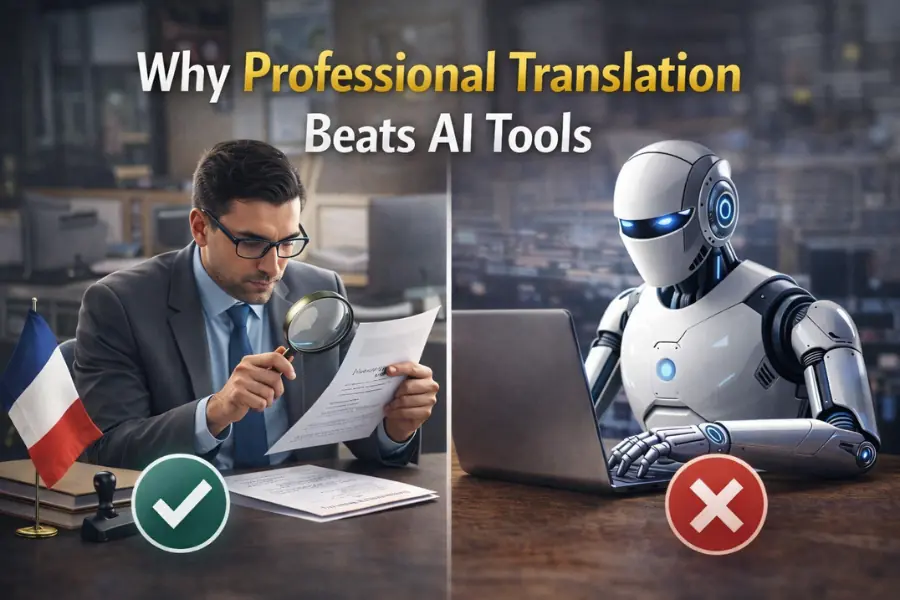
TL;DR: Professional human translation outperforms AI tools for legal, medical, and other high-stakes content, where context, cultural nuance, and accountability matter. AI can be useful for a quick internal draft or a first pass, but courts, immigration authorities, and other official bodies require certified human translation regardless of how good the AI output looks.
The rise of AI translation tools has created a common misconception: that machine translation can replace human expertise. AI has made real progress in language processing, but professional certified translation offers value that goes well beyond swapping words from one language to another.
This guide examines the real differences between AI translation tools and professional human translation, why human translators remain essential for accuracy, nuance, and cultural appropriateness, and where AI genuinely does have a place in the process.
The Evolving Translation Landscape
Translation technology has advanced substantially, with neural machine translation systems achieving real fluency across many language pairs. That fluency is exactly what creates the misconception: text that reads smoothly isn’t the same as text that’s accurate, especially for specialized or legally significant content.
Research bears this out. A 2025 comparative study published in the International Journal of Language and Law found that human translators significantly outperformed AI-generated translations across every criterion assessed for legal documents, including terminology precision and adherence to legal conventions. Courts researching the same question have reached a similar conclusion: the National Center for State Courts’ guidance on machine translation urges real caution, specifically because of the risk that critical information gets mistranslated in high-stakes documents without anyone noticing until it matters.
Professional Translation vs. AI Tools, Side by Side
The two approaches aren’t just different in quality, they’re built for different things entirely.
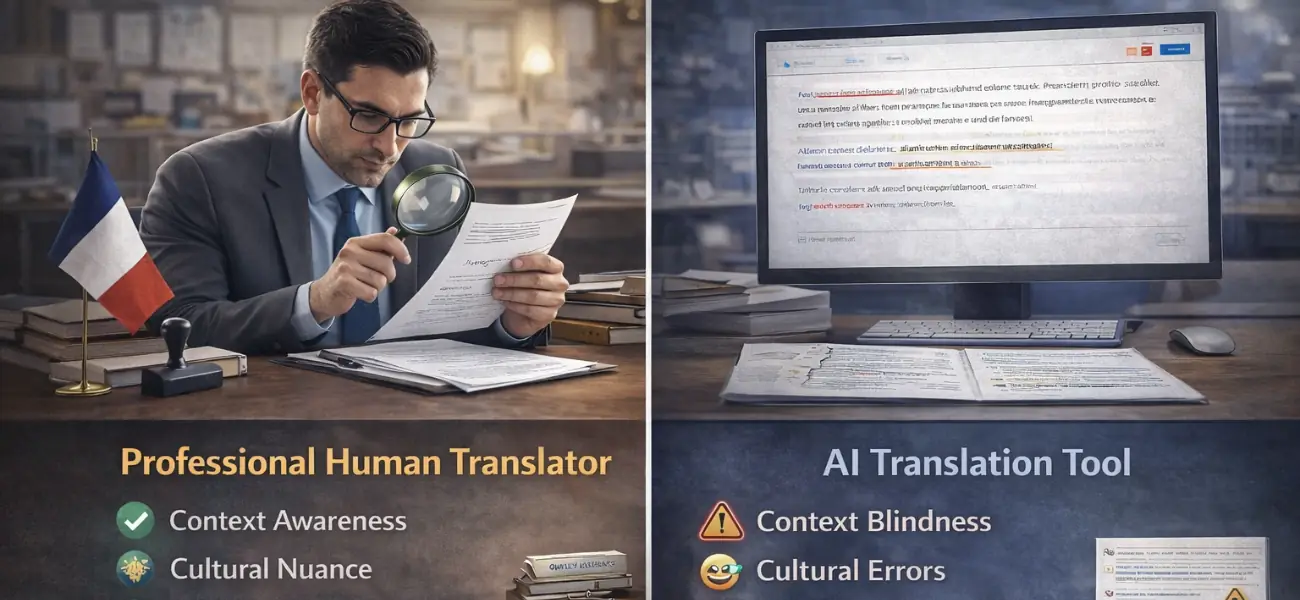
Professional translation: a human translator brings years of specialized training, cultural immersion, and subject-matter expertise to each project. They understand context, nuance, and who the translation is actually for. Key strengths: cultural adaptation, contextual accuracy, specialized terminology, creative localization when a phrase has no direct equivalent.
AI translation tools: these systems analyze patterns in enormous datasets to predict a likely translation. They’re fast and consistent, but they don’t truly understand meaning, context, or cultural subtext, they’re predicting the next plausible word, not reasoning about what the source document means. Key strengths: speed, cost, consistency, handling high volume.
The Human Advantage in Translation
Professional translators bring capabilities AI genuinely can’t replicate, and these advantages matter more as the content gets more complex.
Contextual Understanding
Human translators understand context, intent, and subtext. They recognize when a word has multiple meanings and choose the right one for the specific situation, handling ambiguous phrasing and cultural references that consistently trip up AI systems.
Cultural Nuance
Professional translators act as cultural mediators, not just language converters. They adapt content to be culturally appropriate for the target audience, preventing mistranslations that are technically accurate but land wrong, or worse, offensively.
Quality Assurance
Professional translation typically involves multiple checks: translation, editing, proofreading, and often a subject-matter expert review. This layered process catches errors a single AI pass has no way to flag, since the system doesn’t know what it doesn’t know.
Specialized Expertise
Many professional translators specialize in a specific field, legal, medical, technical, or financial, developing real depth in that field’s terminology and conventions rather than generic fluency.
Ethical and Legal Compliance
Professional translators work under ethical codes and confidentiality agreements, and understand the legal requirements around certified translation and sensitive data. This accountability matters enormously for legal documents, medical records, and confidential business information.
Creative Problem-Solving
When a concept, idiom, or piece of creative content genuinely doesn’t translate directly, a human translator adapts it rather than translating literally, preserving the meaning and impact instead of producing something technically correct but flat.
Critical Limitations of AI Translation Tools
AI translation has improved significantly, but it still runs into limitations that keep it from matching human quality for anything beyond simple, literal content.
Context Blindness
AI systems translate words and phrases without truly understanding meaning in context. They routinely miss sarcasm, irony, humor, or a subtle shift in tone that changes what a sentence actually means, producing output that’s technically correct but contextually wrong.
Cultural Insensitivity
AI lacks cultural intelligence. It can’t reliably recognize a culturally sensitive topic, adapt content for local norms, or flag when a direct translation might land as offensive or simply strange.
Specialization Gaps
AI systems are trained on broad, general content, which makes them unreliable for fields with precise terminology. Legal, medical, engineering, and financial translation all have specific conventions a generalist model routinely misses or misuses.
The Hallucination Problem in AI Translation
Hallucination, where a machine translation system generates fluent, plausible-sounding output that isn’t actually supported by the source text, is a documented and well-studied problem in neural machine translation research, not a fringe concern. Foundational research on this exact phenomenon has shown that NMT systems can produce fluent output that’s disconnected from the source, particularly when the input is noisy, ambiguous, or falls outside the system’s typical training data.
This is what makes hallucination genuinely dangerous rather than just an occasional quirk: it sounds credible. An AI might mistranslate a medical instruction or a legal term while using entirely convincing professional language, and there’s no obvious red flag telling the reader something went wrong. A human translator, by contrast, recognizes their own uncertainty and either seeks clarification or flags the ambiguity in the source material directly.
Where Professional Translation Is Non-Negotiable
Certain content categories carry stakes high enough that AI tools represent a real, not theoretical, risk.
- Legal documents: require legal validity, precise terminology, and often formal certification. An AI-introduced error here risks contractual invalidity or legal liability, and there’s no accountable party behind the translation to answer for it.
- Medical content: patient safety and regulatory compliance depend on precise terminology. A mistranslated dosage or instruction is a patient-safety issue, not a stylistic one.
- Marketing materials: brand voice, cultural adaptation, and persuasive power all depend on judgment AI doesn’t have. A tone-deaf or culturally inappropriate campaign can damage a brand well beyond the cost of the translation itself.
Legal Requirements for Certified Translations
Many official documents require USCIS certified translations performed by qualified professionals. Immigration documents, academic transcripts, legal contracts, birth certificates, and government submissions typically can’t be satisfied with an AI translation, regardless of how accurate it happens to be.
A certified translator provides a signed statement attesting to the accuracy and completeness of their work, accepting personal, professional responsibility for it. This certification is what courts, government agencies, and educational institutions actually require. AI translations can’t be certified in this sense, since there’s no accountable professional behind the output. Where certified translation is required, professional human translation isn’t just the better option, it’s the legally necessary one. See our complete guide to certified document translation for the full requirements.
When AI Translation May Be Enough
Professional translation is the right call for critical content, but AI tools can genuinely be adequate for lower-stakes situations: a quick internal email between colleagues who just need the gist, a rough first pass on a large volume of content that will get a full human review anyway, or casual personal correspondence where no legal, medical, or financial consequence hinges on precision. The line isn’t about the tool being “bad,” it’s about matching the tool to what’s actually at stake.
Hybrid Approach: Best of Both Worlds
Many organizations get real value from combining both approaches rather than treating it as an either-or choice.
- Step 1, AI initial translation: use AI for a first draft, especially for large volumes of content or a tight deadline. Best for internal documents, first drafts, and content triage, where speed and cost efficiency matter most.
- Step 2, human editing and post-editing: a professional translator reviews, corrects, and refines the AI output for accuracy and quality. This is higher quality than AI alone and faster than translating from scratch, a good fit for most business content where quality matters but full certification isn’t required.
- Step 3, full professional translation: critical content gets translated entirely by a professional with the right specialization. Best for legal, medical, marketing, and any other high-stakes content, where quality, legal validity, and cultural appropriateness aren’t optional.
Translation Approach Decision Guide
Use this as a quick reference for matching the approach to what’s actually at stake:
| If your content is… | Use… | Why |
|---|---|---|
| A legal, immigration, or government document | Full professional translation | Certification is legally required; AI output can’t be certified |
| Medical information | Full professional translation | Patient safety depends on precise, unambiguous terminology |
| Customer-facing marketing content | Full professional translation, or AI draft plus human editing for lower-stakes campaigns | Brand voice and cultural fit need human judgment |
| General business content, internal memos | AI draft plus human editing | Balances speed and cost against acceptable quality |
| Casual, low-stakes personal use | AI alone is often fine | No legal, medical, or financial consequence hinges on precision |
A quick checklist if you’re still unsure: will this be submitted to a court, government agency, or official institution? Could an error cause legal, financial, or safety harm? Do you need a named, accountable professional standing behind the translation? A “yes” to any of these means professional translation, not AI, is the right call.
The Irreplaceable Value of Professional Translation
AI translation tools have made real progress and offer genuine benefits for certain applications, but they don’t replace professional human translators for content where accuracy, nuance, cultural appropriateness, and legal validity matter. The human advantage in understanding context, adapting to culture, handling specialized terminology, and providing professional accountability remains decisive for exactly the content where getting it wrong is costly.
For businesses and individuals operating across languages, the choice between AI and professional translation should come down to what’s actually at stake: content criticality, audience expectations, and the real consequences of an error. In many cases, the hybrid approach, AI for speed where it’s appropriate, professional translation where it matters, is the most practical answer. The question isn’t whether AI will replace human translators. It’s how the two work together to produce the best outcome for whatever you’re actually trying to communicate.
Frequently Asked Questions
Order Your Translation Now & Get These
Features IN THE SAME PLACE:


Reviewed by Vyvyan Evans - Language Expert