TL;DR: A birth certificate translation for USCIS or other authorities must be certified: a complete, word-for-word English translation done by a qualified third party, not a family member. Certification is usually enough for USCIS. Notarization and apostille are only needed for specific courts or countries. Expect $22.99 to $60 per page and 24 to 48 hour delivery for a standard, single-page document.
Imagine submitting your visa application only to have it rejected because of a mistranslation in your birth certificate. It’s a scenario that happens more often than you’d think, derailing plans for work, study, or family reunions abroad. An accurate, certified English translation isn’t just helpful, it’s essential for proving your identity and avoiding costly delays.
This guide covers why certification matters, step-by-step instructions, common errors to avoid, and how to choose a provider, whether you’re applying for a U.S. visa, university admission, or something else entirely. We’ve kept this practical and specific rather than generic, with real cost breakdowns and the exact wording USCIS and other authorities are actually checking for.
Related guides in this series:
Why a Certified Translation of a Birth Certificate Is Essential
A birth certificate is far more than a record of your birth date and place. It’s fundamental proof of your identity, parentage, and citizenship status. For USCIS, universities, or employers in English-speaking countries, a certified translation is non-negotiable.
What sets a certified translation apart from a casual one? It’s a full, word-for-word rendition of the entire document, including handwritten notes, stamps, seals, or signatures on the original. The translator provides a signed statement affirming the translation’s accuracy and completeness, along with their qualifications in both languages.
Without certification, your application risks real setbacks. Per USCIS’s own evidence guidance, a foreign-language document submitted without a proper certified translation can lead to rejection or a Request for Evidence, adding weeks or months to processing. Incomplete translations and uncertified submissions are consistently among the most common reasons these applications get flagged in the first place, which is exactly why the certification step isn’t optional paperwork, it’s the thing authorities are actually checking for. Attempting self-translation is particularly risky: USCIS explicitly prohibits translations by the applicant or family members, and such attempts often trigger automatic rejection or added scrutiny.
Most people today use specialized agencies experienced in legal and immigration translation specifically, rather than a general-purpose translation service, since these providers understand how requirements differ across receiving authorities and can maintain the original document’s layout in a way that holds up to comparison against the source.
When choosing a provider, look for real experience with cases like yours, genuine linguistic expertise, industry credentials, and a track record you can verify through reviews, not just marketing claims. A provider that’s vague about any of these four is worth a second look before you commit your document to them.
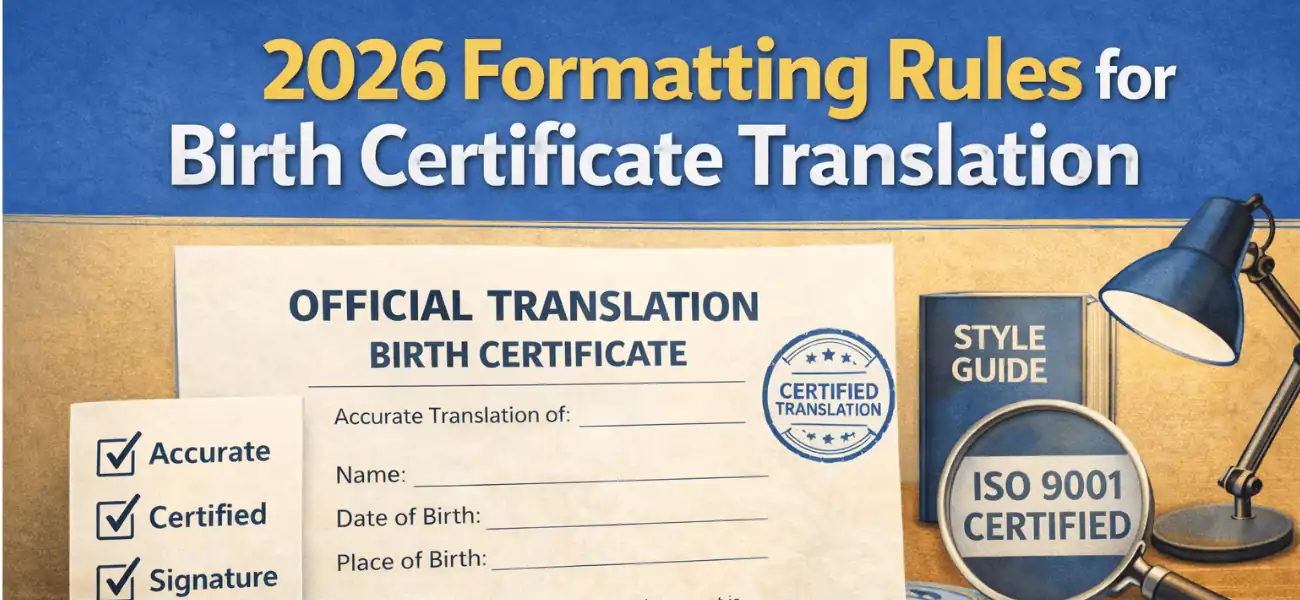
2026 Formatting Rules for Birth Certificate Translation
USCIS has emphasized formatting standards that streamline digital processing. Translations should mirror the original document’s structure as closely as possible, including describing or transcribing the placement of stamps, seals, and signatures rather than omitting them because they aren’t translatable text in the usual sense. For scanned submissions, a minimum resolution of 300 DPI is recommended for legibility, blurry or low-resolution scans are a common, entirely avoidable cause of delay. Digital formats like PDFs are widely accepted, provided they include electronic signatures that meet verification standards rather than a scanned signature pasted into the file.
Other countries are adopting similar digital-friendly policies. Canada’s IRCC, for instance, prioritizes high-quality scans to speed up Express Entry reviews, following the same logic that a clean, legible source document is what lets automated intake systems process a case quickly rather than routing it for manual review.
Certified vs. Notarized Translation, in Brief
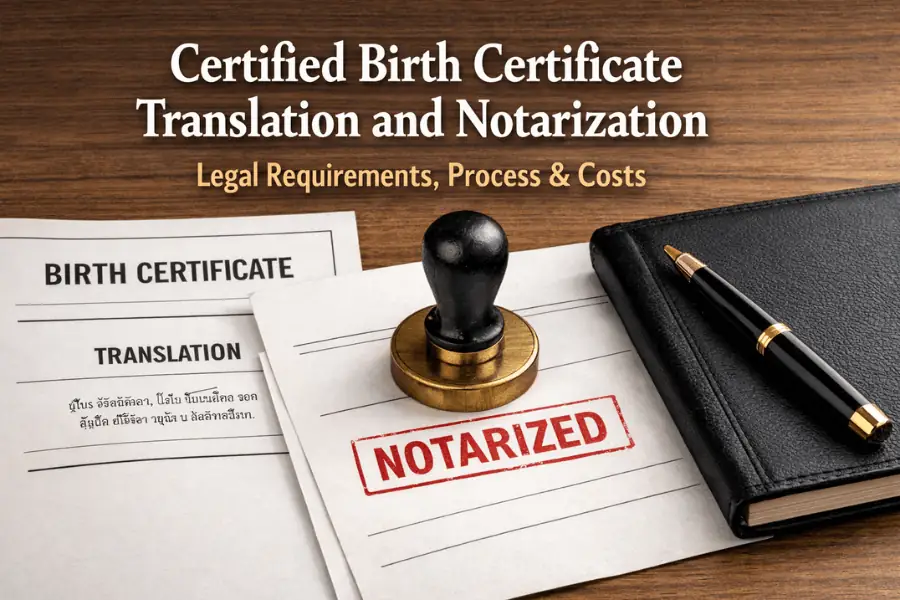
A certified translation confirms the accuracy and completeness of the work itself. A notarized translation adds a notary public verifying the translator’s identity, not the translation’s accuracy. For most USCIS purposes, certification alone is enough, but some courts, foreign consulates, and Hague Convention destinations require notarization or an apostille on top of it. For the full comparison, including a country-by-country breakdown, see our certified vs. notarized translation guide and our legal requirements by country guide. For the federal authentication process itself, the State Department’s apostille requirements page covers when that step applies.
When You’ll Need a Birth Certificate Translation
- Immigration and visa applications, for USCIS processes like green cards or naturalization
- University admissions abroad, to verify age, identity, and scholarship eligibility
- Marriage in a foreign country, proving parentage and identity for overseas weddings or spousal visas
- Applying for dual citizenship, since countries like Canada via IRCC require accurate translations to establish lineage
- Legal name changes, since courts need it to confirm original details before approving modifications
- Work permits and professional licensing, since employers or licensing boards may require it for background checks
Related documents often follow the same process and can be bundled with your birth certificate translation for efficiency, marriage certificates, diplomas, and passports among them, since ordering them together with one provider usually means one set of formatting rules to satisfy instead of juggling several vendors’ conventions.
As more countries digitize records and shift to online portals, requirements keep evolving. USCIS now accepts scanned digital versions for e-filings, provided they still include the full certified translation with electronic signatures. Transliteration checks for non-Roman scripts, Arabic, Chinese, or Urdu names among them, are getting stricter, since phonetic accuracy is what prevents a name mismatch in official records down the line, at a passport office, a university registrar, or a future visa renewal. See our Urdu birth certificate translation guide as one concrete example of how this works in practice. Even with digital-first processing becoming the norm, some embassies and consulates still request a physical hard copy for verification, so it’s worth confirming which format your specific destination actually wants before you assume a PDF is sufficient.
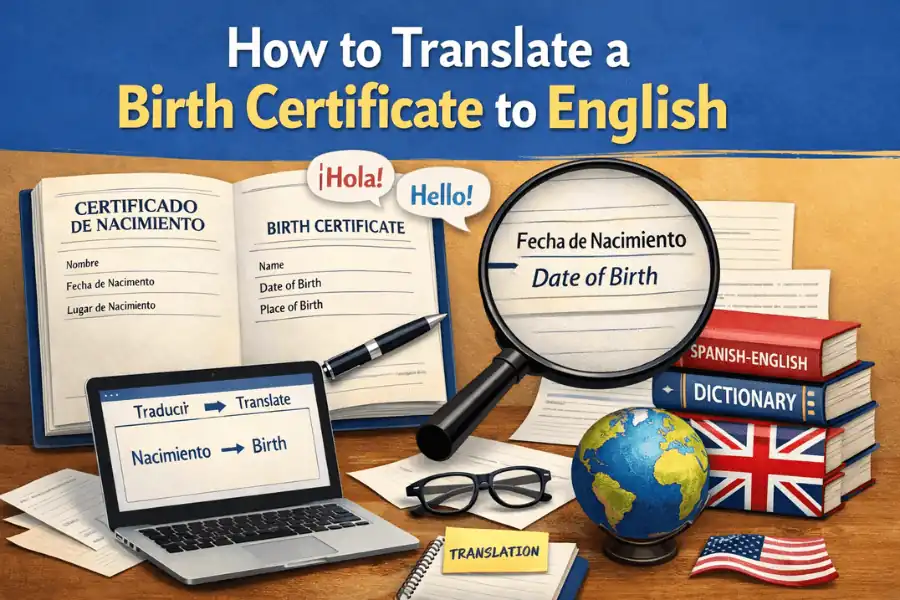
Step-by-Step: How to Translate a Birth Certificate into English
Translating a birth certificate isn’t a DIY task for legal purposes. Here’s the process:
- Step 1: Check the specific requirements. Research the receiving authority’s exact standards before you order anything. USCIS mandates a full English translation covering all elements, certified by someone fluent in both languages, not a family member. Some countries require sworn translators registered with a court or ministry, others insist on notarization, and a few want both. Knowing which applies to you before you order saves a second round of paperwork later.
- Step 2: Choose a professional translation service. AI translation tools have advanced, but for legal documents, human expertise still matters more than raw speed. A 2025 comparative study published in the International Journal of Language and Law found human translators significantly outperformed AI-generated translations across every criterion assessed for legal documents, including terminology precision and adherence to legal conventions. Courts researching this same question have reached a similar conclusion: the National Center for State Courts’ guidance on machine translation urges caution specifically because of the risk that critical information gets mistranslated in high-stakes documents. A professional service pairs that human expertise with the certification USCIS and other authorities actually require.
- Step 3: Provide a clear copy of the original. Submit a high-resolution scan or photo, at least 300 DPI. If the document is damaged or faded, tell the service upfront so they can annotate ambiguities without altering meaning, rather than discovering the issue partway through and delaying the turnaround.
- Step 4: Review the draft. Reputable agencies provide a draft for your approval before finalizing anything. Check names, especially transliterations, dates, and places carefully, since small discrepancies here are exactly the kind of thing that triggers a rejection later, and they’re far easier to fix in a draft than in a submitted document.
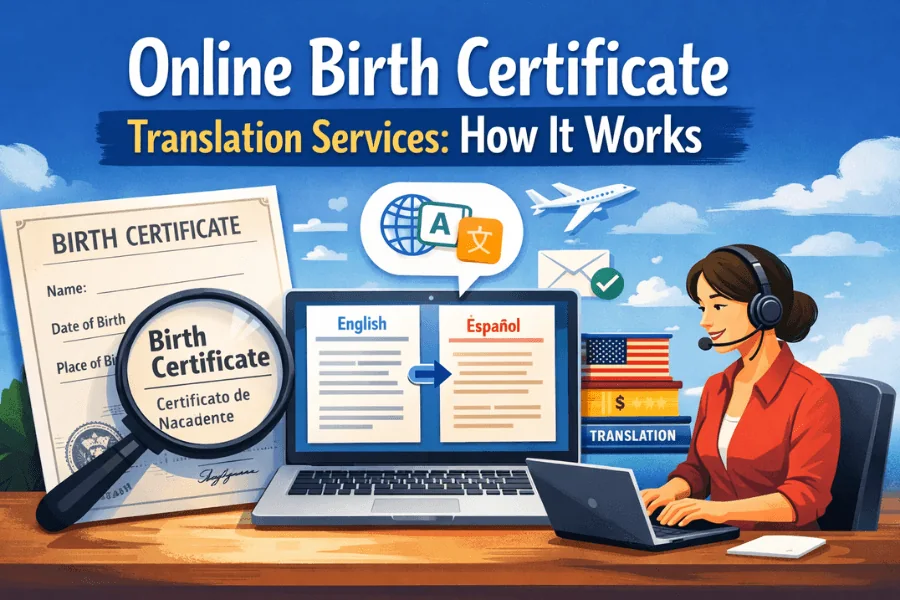
- Step 5: Receive and submit your certified translation. The final package includes the translation, certification statement, signature, and date. For digital submissions, secure PDFs with electronic signatures are accepted as valid equivalents to physical ones. To understand the full online workflow from upload to delivery, read our article on online birth certificate translation services.
- Step 6: Handle transliteration and special cases. For non-Roman scripts, ensure expert transliteration to match phonetic standards and avoid database mismatches with your other identity documents. If the original has damaged sections or missing details, the translation should note these clearly rather than leaving a gap that looks like an omission.
If you have multiple documents, bundling translations together can save time and reduce cost through package pricing from a single provider, rather than paying separate rush fees and certification statements across several vendors.
Choosing the Right Translation Provider
- Specialization in certified translations for immigration and legal purposes. A generalist translator may be fluent but unfamiliar with what USCIS or a court specifically expects in a certification statement.
- A proven track record with your target country’s requirements. USCIS and IRCC compliance aren’t the same thing, and a provider experienced with one isn’t automatically current on the other.
- Fast turnaround, typically 24 to 48 hours, without sacrificing quality. Rush service should mean faster scheduling, not a skipped review step.
- Transparent pricing with no hidden fees, and guarantees like free revisions. A quote that doesn’t separately break out certification, notarization, and rush fees makes it hard to compare providers fairly.
Look for reviews and real client examples that show how a provider handles edge cases, rare languages or urgent deadlines, not just their general marketing claims.
Common Mistakes to Avoid
Small errors in birth certificate translation cause disproportionately large headaches. The most frequent ones:
- Submitting uncertified translations. USCIS rejects these outright, no matter how accurate the wording is, since the certification statement itself is the requirement, not just the translated text.
- Using translators unfamiliar with legal formatting. This commonly leads to omitted stamps or seals, which reads as an incomplete document even when every word of prose was translated correctly.
- Overlooking name spelling or date format variations. A name that doesn’t match your passport, or a date format switched between day-first and month-first conventions, causes identity mismatches that can stall an entire application.
- Providing low-quality scans. A blurry or cropped original produces an illegible translation and often triggers a Request for Evidence over something that had nothing to do with the translator’s skill.
Double-checking against the receiving authority’s official guidelines before you submit, and having a second person review names and dates, catches most of these before they become a problem.
For the full breakdown of these and other rejection causes, see our guide on why certified translations get rejected.
How Much Does It Cost to Translate a Birth Certificate?
Cost depends mainly on the language pair (rarer languages cost more than common ones, since fewer qualified translators are available), urgency, document length, and extras like notarization or apostille assistance. A rush order in a rare language pair can run noticeably higher than a standard-timeline order in Spanish or French, even for the identical one-page document. Expect $22.99 to $60 per page for a standard document up to 250 words. For comparison against other providers in the market:
- Pro Translation Service: $22.99 to $60 per page, with full certification
- RushTranslate: $24.95 per page
- ASAP Translate: $24.90 per page
- ImmiTranslate: $25 per page, standard
- RapidTranslate: $27.99 per page
- MotaWord: roughly $0.08 to $0.30 per word, often totaling $20 to $50 per page
Notarization typically adds $15 to $30, depending on the provider. Bundling multiple documents with a single provider can help keep costs down.
Supported Languages and Country-Specific Notes
Professional birth certificate translation services support over 100 languages, from common ones like Spanish, French, and German to rarer ones such as Arabic, Mandarin, Hindi, Russian, and Swahili. Rarer language pairs typically take a bit longer to staff and cost somewhat more, simply because fewer qualified translators are available for them.
Requirements also shift by destination in ways that go beyond the language itself. A translation accepted by USCIS with certification alone may need an added sworn translator or notarization step for the UK, Canada, Australia, or an EU country. For the specific certification, notarization, and apostille requirements by destination, see our legal requirements by country guide and our full list of countries we cover.
Frequently Asked Questions
Ready for your birth certificate translation? Get started with a compliant, stress-free service and have it delivered to your inbox. Whether your document is headed to USCIS, a university, or a foreign consulate, getting the certification, formatting, and country-specific requirements right the first time is what keeps your timeline on track instead of adding weeks to it.
Order Your Translation Now & Get These
Features IN THE SAME PLACE:


Reviewed by Ann-Charlotte Storer - ATA-Certified English–Swedish Translator