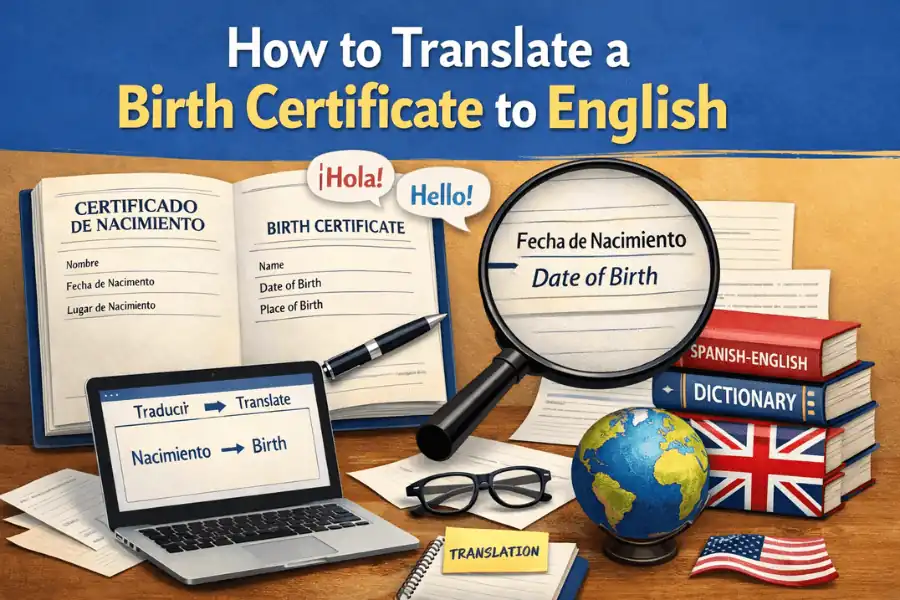
A birth certificate is more than a record of birth. It is a legal key to passports, visas, citizenship, marriage registration, education, and immigration benefits.
But when that document is in another language, a simple translation is not enough. Authorities require a certified translation that guarantees accuracy, completeness, and legal validity.
This guide explains exactly what makes a birth certificate translation certified in 2026, the official requirements, the certification process, common mistakes to avoid, global standards, costs, and how to choose a trusted service so your document is accepted the first time.
Understanding Certified Translations
At its core, a certified translation goes far beyond a straightforward linguistic conversion. It serves as a legally binding assurance that the translated document faithfully mirrors the original in every detail, from the wording to the intent.
The translator or translation agency provides a formal declaration, often attached as a separate page, affirming that the work is both complete and precise. This statement typically includes the translator’s qualifications, confirming their fluency in the source and target languages, along with their contact information for verification purposes.
In the United States, certification does not require a government-issued license, but the process demands transparency and accountability. The translator must include their full name, signature, address, and the date of completion, creating a trail of responsibility that institutions like the U.S. Citizenship and Immigration Services (USCIS) can follow if needed.
This approach builds trust, as the certification essentially puts the translator’s professional reputation on the line. For a broader understanding of how certification fits into the overall legal framework, including when notarization becomes necessary, read our certified birth certificate translation and notarization guide.
Special Considerations for Birth Certificates
For birth certificates specifically, the stakes are even higher due to the document’s intricate elements. These often include official seals, registrar stamps, marginal notes, and sometimes even corrections or amendments added over time.
A certified translation must replicate all these features accurately, describing non-translatable elements like emblems or watermarks in clear terms. The goal is to produce a document that looks and functions just like the original, but in the target language.
Broader Implications
This rigor protects against misunderstandings that could lead to serious consequences, such as rejected applications or disputes over identity. As global mobility increases, with the United Nations estimating the international migrant stock at 304 million in mid-2024, the demand for such precise translations continues to surge, making certification a cornerstone of international documentation.
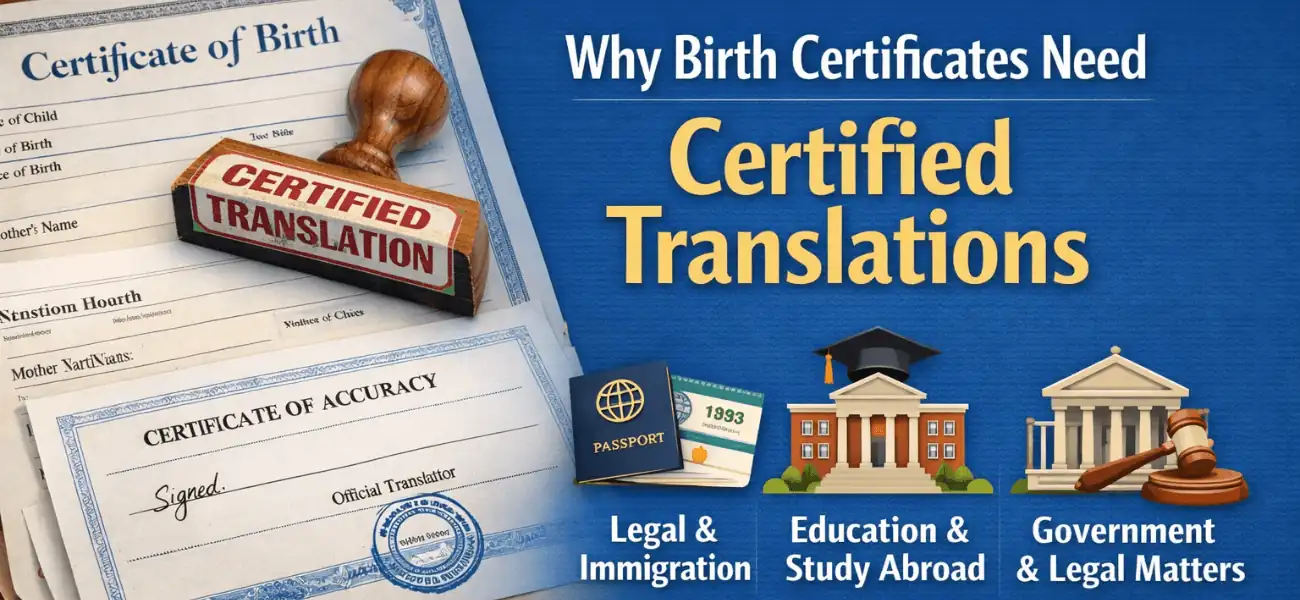
Why Birth Certificates Need Certified Translations
Birth certificates surface in countless life milestones, serving as the foundational proof of identity.
Key Applications
Whether you are pursuing a visa, enrolling in school overseas, or handling inheritance matters, this document often stands at the center.
In immigration contexts, for instance, it verifies age, parentage, and nationality, elements that can make or break an application.
Without a certified translation, even the most straightforward process can grind to a halt.
U.S. Requirements
In the United States, USCIS requires certified translations for all foreign-language documents in:
- Green card applications
- Naturalization filings
- Family-based petitions
- Immigration and visa processes
This requirement exists to prevent identity errors such as:
- Misspelled names
- Incorrect dates of birth
- Mismatched parental details
Even minor inaccuracies can trigger delays, Requests for Evidence (RFEs), or denials.
International Standards
Internationally, similar standards apply. In the European Union, while documents in official EU languages might not need translation for certain administrative purposes, birth certificates from non-EU countries often require certified versions for residency, marriage, or employment.
Nations like Germany and France frequently insist on translations by sworn translators, who are officially appointed by courts to ensure impartiality and expertise.
This practice minimizes the risk of fraud, as certified translations provide a verifiable chain of custody from the original document.
Risks of Inaccuracy
Certification exists because inaccuracies cause real legal and identity risks. A simple error, such as confusing a middle name with a surname, could lead to identity verification failures or legal complications down the line.
Migration Trends
With global migration trends showing no signs of slowing, as evidenced by the Organisation for Economic Co-operation and Development reporting 6.2 million new permanent immigrants in its member countries for 2024, the volume of birth certificate translations has skyrocketed.
This surge reflects not just paperwork demands but the human stories behind them: families reuniting, professionals seeking new horizons, and individuals building fresh starts.
Certified translations bridge these gaps, turning potential barriers into open doors.
The Role in Immigration and Legal Processes
Beyond basic identification, birth certificates play pivotal roles in complex legal scenarios. For asylum seekers, they might substantiate claims of persecution based on age or family ties.
In adoption cases, they confirm biological relationships or the absence thereof.
Certified translations ensure these sensitive details are conveyed without distortion, preserving the integrity of the proceedings.
Everyday Applications and Long-Term Benefits
Even outside formal immigration, certified translations prove invaluable. Applying for dual citizenship? Registering a child for school in a new country?
These routine steps often hinge on accurate documentation.
Over time, having a certified version on hand saves repeated efforts and costs, providing peace of mind in an unpredictable world.
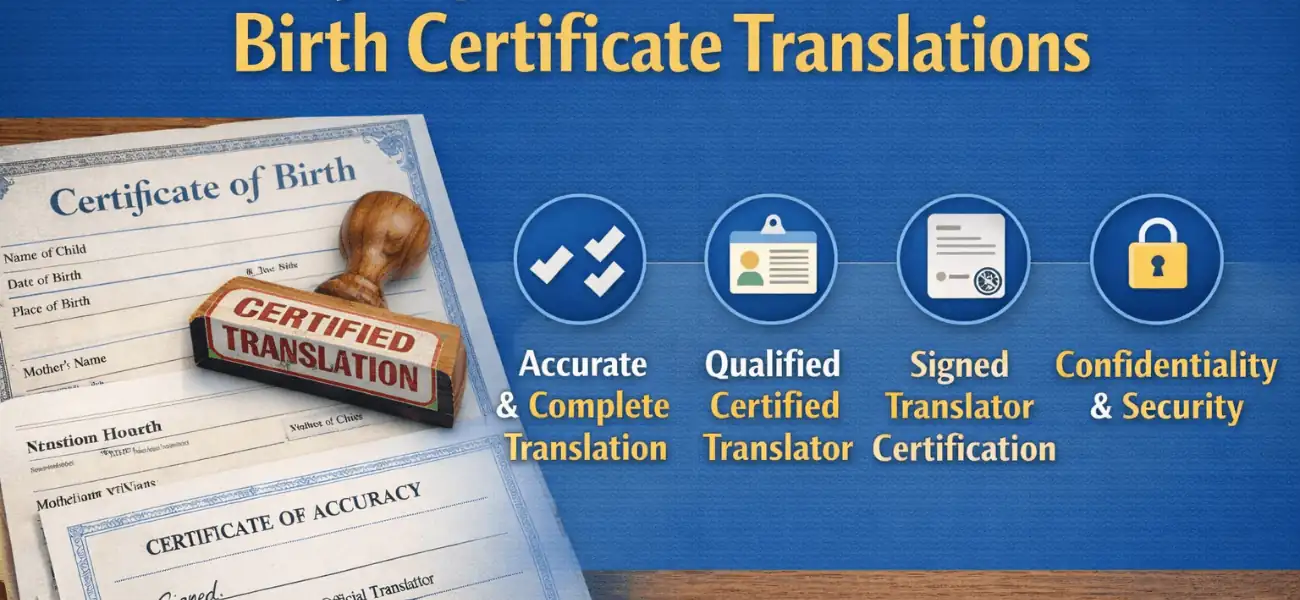
Key Requirements for Certified Birth Certificate Translations
Achieving certification for a birth certificate translation involves adhering to a set of non-negotiable standards, updated as of February 2026.
These guidelines, drawn from USCIS policies and international best practices, prioritize completeness and verifiability.
Completeness Rules
First and foremost, the translation must encompass every element of the original document. This means translating all text, including printed information, handwritten entries, and any annotations on the back.
Seals, stamps, and signatures require descriptive translations, such as noting “Official Seal of the Registrar” where applicable.
Omissions, even minor ones, can invalidate the entire submission.
Certification Statement Details
The certification statement must include:
- Declaration of complete and accurate translation
- Source language and target language
- Translator’s full name
- Signature
- Address
- Phone number
- Date of certification
USCIS accepts digital signatures, making digital submissions legally valid for certified translations.
Translator Qualifications
Translator qualifications matter immensely. While no formal U.S. certification is mandatory, the individual must demonstrate proficiency through experience or education.
USCIS discourages using relatives or self-translations, viewing them as potentially biased.
Professional agencies often employ linguists with specialized knowledge in legal terminology, ensuring nuances like regional dialects are handled correctly.
Formatting Guidelines
Formatting plays a crucial role. The translated document should mimic the original’s layout as closely as possible, maintaining tables, line breaks, and the positioning of key elements.
This visual fidelity helps reviewers quickly cross-reference details.
For international use, some countries may require an apostille, a separate authentication step under the Hague Convention, but USCIS typically does not.
These standards have remained consistent, with USCIS reiterating in early 2026 that notarization is unnecessary for most filings, focusing instead on the certification’s content.
By meeting these criteria, you create a document that not only complies but also withstands rigorous examination.
Essential Components of the Certification Statement
Crafting the statement requires precision. Include the document’s title, languages involved, and a confirmation of the translator’s impartiality.
Variations exist for different jurisdictions, but clarity is universal.
Handling Special Features in Birth Certificates
Documents from older eras might feature archaic language or faded ink. Translators describe illegible parts transparently, noting “illegible” to avoid assumptions.
The Certification Process Step by Step
Navigating the certification of a birth certificate translation is a methodical journey, accessible even to those new to the process. As of 2026, advancements in digital tools have made it more efficient than ever, particularly through online birth certificate translation services.
Initial Preparation
Begin by scanning or photographing your birth certificate. Ensure high resolution to capture fine details like seals or watermarks.
Include all pages, front and back, to avoid incompleteness issues.
Selecting a Provider
Next, select a reputable translation service. Prioritize those with proven track records in official documents, perhaps verified through reviews or affiliations with bodies like the American Translators Association.
Submission and Payment
Submit your scan via their secure portal, specifying the target language and any deadlines.
Payment follows, with fees reflecting the document’s complexity and urgency.
Translation Execution
Once processed, a professional translator begins the work.
They employ specialized software for initial drafts but conduct manual reviews to catch cultural or contextual subtleties that machines might miss.
Final Certification
Upon completion, the translator attaches the certification statement, detailing their credentials and affirming accuracy.
You receive both digital and, if requested, physical copies.
For USCIS submissions, pair the translation with the original or a certified copy.
This streamlined process typically delivers certified translations within 24 to 48 hours.
Many providers offer acceptance guarantees, promising revisions if authorities raise concerns.
Preparing Your Document for Translation
Quality scans prevent errors. Use flatbed scanners for crisp images, and avoid glare from glossy surfaces.
Post-Translation Review and Submission
Double-check the translation against the original. While not mandatory, this step catches rare oversights before official filing.
Choosing the Right Translation Service in 2026
In an era dominated by technological advancements, selecting a translation service demands careful consideration.
Human expertise remains irreplaceable for certified work, where context and subtlety are paramount.
AI tools excel at speed but falter on legal precision, which often leads to rejections.
Evaluation Criteria
Evaluate services based on experience. Seek those with high USCIS acceptance rates, ideally above 99 percent, and positive client testimonials.
Specialization in birth certificates or immigration documents signals reliability.
Language coverage is key. Ensure they support your specific source language, including less common ones like Tagalog or Amharic.
Turnaround times vary, but 24 to 48 hours is standard for urgent needs.
Look for guarantees, such as free revisions or refunds if the translation is not accepted.
In 2026, top providers integrate secure digital platforms for uploads and tracking, enhancing convenience without compromising quality.
Avoid bargain options; they may cut corners on certification, risking your application’s success.
Evaluating Translator Credentials
Check for memberships in professional organizations and years in the field. Portfolios of similar work provide insight.
Security and Confidentiality Measures
Reputable services use encryption and non-disclosure agreements to protect sensitive personal information.
Costs Involved in Certified Birth Certificate Translations
Pricing for certified birth certificate translations hinges on several factors, reflecting the industry’s growth and complexities.
In 2026, averages range from 25 to 55 USD per page for common languages like Spanish or Mandarin, with birth certificates typically counting as one page.
Rarer languages, such as Swahili or Khmer, command higher fees, often 40 to 60 USD, due to limited translator availability.
Expedited services add 10 to 20 USD for 24-hour turnaround.
Additional certifications, like notarization when required by certain courts, tack on 10 to 20 USD.
For international validation, an apostille might cost 50 to 100 USD through government channels.
Industry reports peg the global language services market at 75.7 billion USD in 2025, driven by migration and e-commerce.
This expansion has stabilized costs, but quality varies.
Investing in reputable providers prevents costlier delays from rejections.
Breaking Down Fee Structures
Base fees cover translation and certification. Surcharges apply for complexity, like deciphering handwritten notes.
| Service Type | Average Cost (USD) | Notes |
| Standard Certified Translation | 25-35 per page | For 250 words or less; includes certification. |
| Expedited (24 hours) | 35-50 per page | Rush fee added. |
| Notarized (if needed) | +10-20 | Extra for notary stamp. |
| Apostille | 50-100 | For international use. |
| Rare Language (e.g., Swahili) | 40-60 per page | Higher due to fewer translators. |
Budgeting Tips for Multiple Documents
Bundle translations for discounts. Plan ahead to avoid rush fees.
Latest Statistics and Trends in the Translation Industry
The translation sector is experiencing robust expansion, fueled by globalization and technological innovation.
According to recent analyses, the global market reached 71.7 billion USD in 2024 and is projected to hit 75.7 billion USD in 2025, growing at a steady 5.6 percent annually.
This trajectory reflects increasing demands from e-commerce, which requires seamless multilingual content, and rising migration flows.
AI Integration
AI integration stands out as a major trend. While machine translation achieves 94 percent accuracy for straightforward languages like Spanish, human oversight remains essential for complex documents.
Hybrid models, combining AI drafts with professional editing, reduce costs by up to 30 percent while maintaining quality.
Multimedia Localization
Multimedia localization is booming, with the dubbing and subtitling market valued at 13 billion USD in 2024. Streaming platforms drive this, adapting content for diverse audiences.
For birth certificates, trends lean toward digital certifications, speeding up processes amid USCIS’s push for efficiency.
Demand from Immigration
Immigration surges amplify demand. USCIS processed millions of applications in 2025, with a 15 percent rise in certain categories, heightening the need for certified translations.
Sustainability emerges as a focus, with services adopting eco-friendly practices like paperless workflows.
Here is a table summarizing key industry statistics:
| Metric | Value | Year | Source |
| Global Language Services Market | 71.7 billion USD | 2024 | Nimdzi |
| Projected Market Size | 75.7 billion USD | 2025 | Nimdzi |
| AI Accuracy for Spanish | 94% | Recent | Industry Reports |
| Dubbing and Subtitling Market | 13 billion USD | 2024 | Market Analysis |
| USCIS Application Rise | 15% | 2025 | USCIS Data |
Impact of AI on Translation Quality
AI accelerates initial drafts but requires human refinement for idiomatic expressions.
Growth in Specialized Sectors
Legal and medical translations see heightened demand, with tailored training for translators.
Recent News in Document Translation Certification
The landscape of document translation certification evolved notably in 2025.
Translayte earned the Association of Translation Companies’ “Innovator of the Year” award for pioneering secure digital workflows that enhance efficiency without sacrificing accuracy.
USCIS issued clarifications in January 2026, reaffirming that notarization is not required for most immigration filings, emphasizing robust certification statements instead.
This move aims to expedite processing amid backlogs.
AI Debates
Debates on AI persist. A 2025 study highlighted that purely AI-generated translations trigger Requests for Evidence more frequently due to overlooked cultural contexts.
Experts advocate for human-led approaches in certified work.
In the EU, updated regulations simplified translations for official languages but maintained stringent requirements for non-EU documents, promoting sworn translators for consistency.
These shifts signal a more accessible yet rigorous environment, benefiting users while upholding standards.
Regulatory Updates and Their Implications
New EU rules ease intra-union document handling but tighten external verifications.
Innovations in Certification Technology
Blockchain-based verifications emerge, offering tamper-proof records.
Common Mistakes to Avoid in Certified Translations
Errors in certified translations can derail important applications, but awareness helps prevent them.
As of 2026, here are pitfalls to watch:
- Overlooking the certification statement tops the list. Without this signed affirmation of accuracy, USCIS or similar bodies will reject submissions outright.
- Incomplete translations rank high too. Failing to include stamps, seals, or notes creates gaps that raise suspicions.
- Using family members for translations invites bias claims. Authorities prefer independent professionals.
- Relying solely on AI tools skips necessary human nuance, leading to inaccuracies in context.
- Mismatched formatting confuses reviewers. Align the translation’s structure with the original.
- Inconsistent details, like varying name spellings, spark identity concerns.
- Unnecessary notarization wastes resources when certification suffices.
Always verify before submitting to sidestep these issues.
Spotting and Correcting Errors Early
Compare translations side-by-side. Seek second opinions from experts.
Lessons from Real-World Cases
Anonymous examples show how minor oversights led to months-long delays.
Global Perspectives: Certified Translations in the EU and Beyond
Approaches to certified birth certificate translations vary worldwide, reflecting diverse legal traditions. For a comprehensive breakdown of legal birth certificate translation requirements across major countries including the USA, Canada, UK, Australia, and UAE, consult our detailed country-by-country guide.
EU Practices
In the EU, public documents in official languages often bypass translation for administrative use. However, non-EU birth certificates typically need certified versions, especially for residency or marriage.
France and Germany mandate sworn translators, court-appointed experts who affix official stamps for validity.
North America
Canada’s IRCC requires affidavits for translations done abroad, ensuring completeness and translator impartiality. NAATI accreditation is not needed, but certified professionals are preferred.
Oceania
Australia insists on NAATI-certified translations for immigration, with translators meeting rigorous training and ethical standards.
United Kingdom
The UK accepts certified translations from qualified linguists for most purposes, without mandatory notarization.
Additional Authentication
Apostilles provide international authentication under the Hague Convention, essential for cross-border use.
Understanding these variations ensures compliance wherever your documents travel.
Country-Specific Variations
Japan favors translations by registered professionals for official filings.
Navigating International Apostille Requirements
Obtain apostilles from issuing countries’ designated authorities for global recognition.
Certified birth certificate translations are vital for official needs in 2026. They ensure accuracy, completeness, and trust. By understanding requirements, avoiding mistakes, and choosing good services, you can handle this smoothly. With industry growth and tech aids, it’s easier than ever. Remember: It’s not just words; it’s your story, told right.
Frequently Asked Questions
Final Conclusion:
Certified birth certificate translations are not just a technical requirement. They are a foundation of trust in legal, immigration, and international systems. Accuracy, completeness, and proper certification protect your identity, your applications, and your future opportunities.
By understanding the certification standards, avoiding common mistakes, and choosing a qualified translation provider, you ensure your documents are accepted without delays, rejections, or costly corrections. In a world where borders are increasingly crossed and lives are increasingly global, certified translations are essential.
Order Your Translation Now & Get These
Features IN THE SAME PLACE: