If you are applying for a Green Card, visa, or U.S. citizenship, getting your online birth certificate translation right is the difference between approval and a costly Request for Evidence (RFE). Immigration applications are rejected thousands of times each year due to simple translation errors: a flipped date, a missing stamp, or a name spelled incorrectly. In this guide, we cover the USCIS translation requirements, the cost of certification, and a step-by-step process to ensure your document is accepted the first timeusing a reliable online birth certificate translation service.
Picture this. You’ve poured months (maybe years) into your visa, green card, or citizenship application… then bam! A tiny mix-up like a flipped date (DD/MM vs MM/DD), a missing stamp, a name spelled one letter off, or no proper certification statement lands you a Request for Evidence (RFE). Suddenly your timeline stretches by months or worse, the whole thing gets rejected. It happens way more often than you’d think. Thousands of cases get flagged yearly just for translation glitches.
So how does a proper online certified birth certificate translation actually work? It’s straightforward, but it has to be done precisely to avoid those headaches.
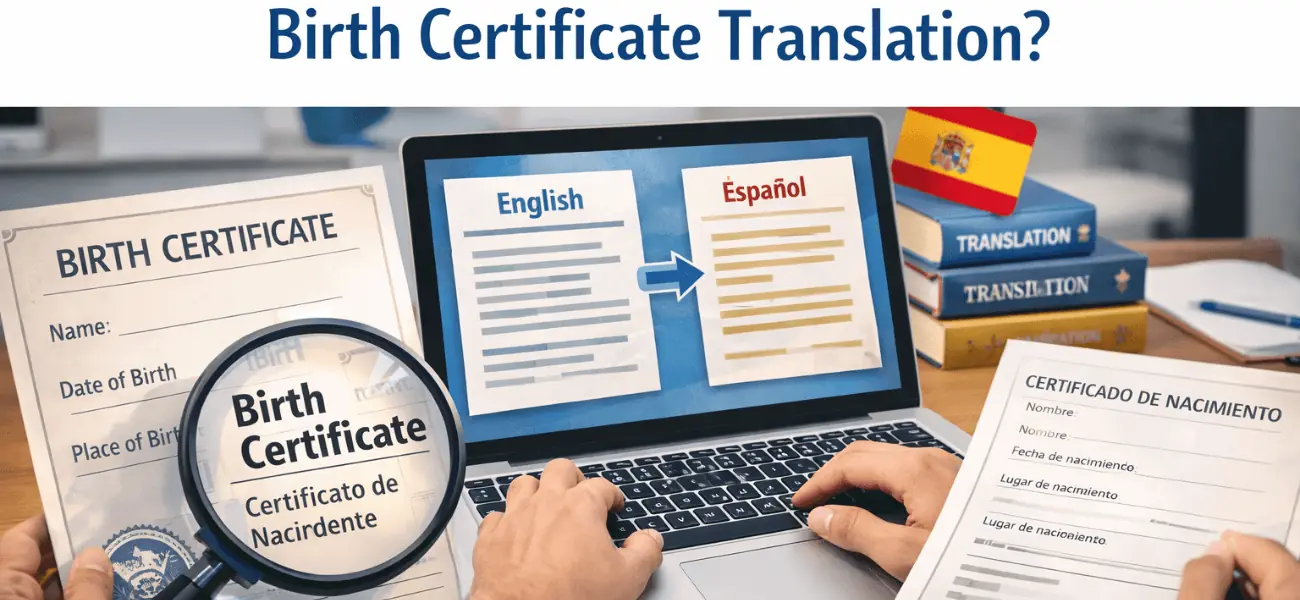
How to Get a Proper Online Certified Birth Certificate Translation?
Upload your original. Scan or photo your foreign birth certificate (the full thing, stamps, seals, handwritten notes and all).
Professional translation; A qualified, fluent translator recreates it word-for-word in English. Nothing summarized, nothing skipped. Every seal, signature, registration number, and marginal note stays exactly mirrored, including the original layout so USCIS can compare side-by-side easily.
Certification magic; The translator adds a signed statement (the key part USCIS demands): something like, “I certify this is a complete and accurate translation. I’m fluent in both languages.” No DIY, no family favors. Must be a neutral pro.
You get the package. Usually a PDF with: original scan + full English version + certification attached. Ready to submit alongside your forms.
Bottom line? Skip the free Google Translate or uncertified shortcuts. They almost always backfire. A legit certified service gets it right the first time, keeps your application moving, and saves you major stress and delays.
Your future is worth those few extra careful steps, right?
What Is an Online Birth Certificate Translation Service?
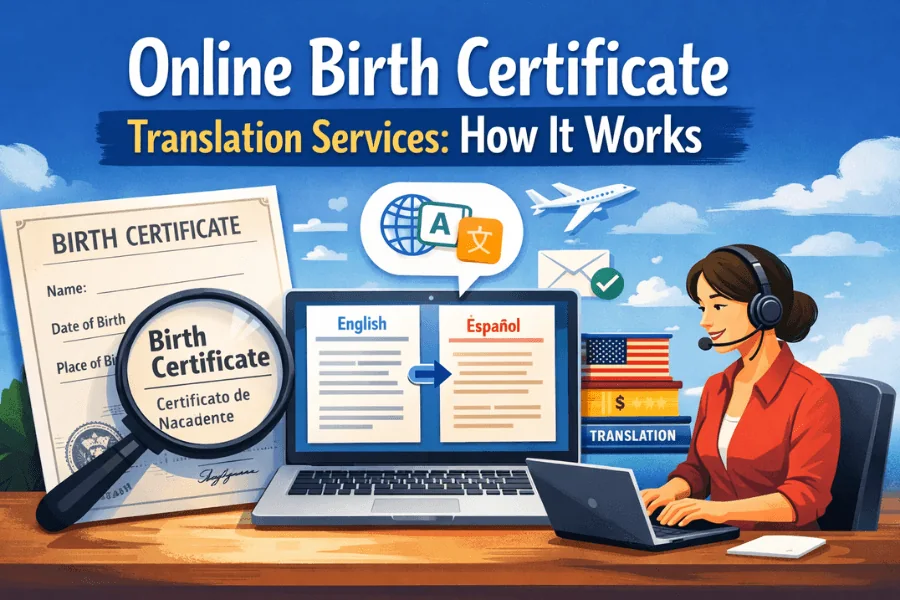
An online birth certificate translation service is a digital offering that lets you submit your foreign birth record (scan, photo, or PDF), receive a professional, certified translation in English, and download or receive the finalized documents electronically. Additional options typically include notarization, apostille guidance, and rush delivery. The main advantage is speed and convenience, but the key is compliance: the translation must meet the legal standards of the receiving authority (USCIS, court, university, embassy).
Step-by-Step: How the Online Birth Certificate Translation Process Works
Here’s a typical, reliable workflow used by top online providers:
Step 1: Upload Original
You upload a clear scan or photo of the birth certificate.
Acceptable formats: PDF, JPG, PNG.
Tip: Include the full original (all pages, stamps, handwritten notes).
Step 2: Select Service Level
Options: Certified translation, Certified + Notarized, Rush (24-48 hours), Apostille assistance.
Choose country of origin (language variant matters).
Step 3: Quote & Payment
Automatic or manual quote based on language, length, and rush needs.
Secure payment via Stripe/PayPal.
Step 4: Assignment to a Specialist
Your file goes to a translator experienced in legal/immigration documents.
For rare languages, a vetted specialist is assigned.
Step 5: Human Translation + QC
Translator produces a verbatim translation including stamps and notes.
Quality assurance: second review by an editor (recommended).
Step 6: Certification
Translator (or translation company) adds a signed affidavit/certification: “I certify that I am fluent in English and [language] and that this translation is complete and accurate to the best of my knowledge.” To understand exactly what makes a birth certificate translation certified, including the specific language required in the certification statement, read our detailed explanation.
Includes name, signature, date, and contact info.
Step 7: Optional Notarization
If requested, a notary public verifies the signature and adds the notarial seal (in-person or RON where legal).
Step 8: Delivery
You receive:
- Certified translation (PDF)
- Scanned copy of the original
- Certification affidavit
- Notarized page (if requested)
Download or email-ready files for submissions
Step 9: Post-Delivery Support
Agency answers questions, adjusts if the receiving authority asks for clarification.
Updated 2026 Regulatory Landscape for Birth Certificate Translations
The legal framework for document translation remains strict heading into 2026. According to the Murthy Law Firm, one of the most respected immigration law practices in the United States, the regulation is clear: “Any document containing foreign language submitted to USCIS shall be accompanied by a full English language translation which the translator has certified as complete and accurate, and by the translator’s certification that he or she is competent to translate from the foreign language into English.”
This requirement, updated in January 2026, reinforces that while you do not need to pay for an “official” government translation service, you must use a qualified translator who provides proper certification. There is no requirement that an official translation service be used, but the certification must be present.
Critical Statistics Every Applicant Should Know in 2026
Understanding the numbers behind translation rejections can help you avoid becoming a statistic. Here are the latest findings from immigration authorities and translation industry reports:
These figures demonstrate that translation errors remain a leading cause of application delays, even as the translation industry experiences explosive growth due to globalization and AI advancements.
Certification, Notarization, and USCIS Compliance for Birth Certificate Translations
What USCIS requires: USCIS and many U.S. agencies require a certified English translation of any foreign-language document. The certification must include a signed statement that the translator is competent in both languages and that the translation is complete and accurate. For a deeper dive into when notarization becomes necessary, see our detailed guide on certification vs. notarization.
Notarization: USCIS does not require notarization. A notary only verifies identity of the signer, not translation accuracy. Notarization is requested by some courts, embassies, or foreign authorities. Online services usually offer notarization as an add-on (in-person or Remote Online Notarization, RON, where allowed).
Key Compliance Checklist for USCIS
- Full verbatim translation of the birth certificate (including stamps/seals)
- Translator’s signed certification (name, signature, date, contact)
- Copy of the original foreign-language document included with submission
- Legible fonts and preserved layout
Format, Layout, and Technical Requirements for USCIS-Accepted Translations
To avoid confusion and rejection, follow these formatting rules:
One-to-one mapping: English translation should mirror the original, same order, same fields.
Translate stamps/handwriting: If a stamp or handwritten note appears, translate it or indicate “[handwritten: …].”
Date formats: Keep original format or clarify (e.g., “Date of birth: 03/04/1990, day/month/year”).
Page numbering: Number pages and include “Page X of Y” if multi-page.
Certification placement: Certification should appear on the last page or attached as a separate affidavit.
Font and spacing: Use clear, readable fonts and preserve table structures.
Common Mistakes That Lead to Rejection (2026 Edition)
Understanding what causes rejections can save you months of delay. Based on analysis from immigration authorities and translation professionals, here are the most frequent errors:
Mistake #1: Skipping the “Small Stuff”
Many applicants ignore details like stamps, handwritten notes, or even blank lines, thinking they are not important. Most immigration and government offices require a complete, word-for-word translation. Leaving anything out can lead to rejection.
Solution: Translate everything. If something is unclear or blank, write it clearly:
- “[Blank]”
- “[Illegible seal]”
- “[Handwritten: ‘Corrected’]”
Mistake #2: Using the Wrong Format
Different countries have different expectations about how official documents should be presented. Here is how requirements compare across major destinations:
| Country | Required Format | Certification Needed? |
| Australia | Line-by-line bilingual | Yes (NAATI-certified) |
| USA (USCIS) | Word-for-word | Yes (Signed and dated) |
| Canada | Paragraph or line-by-line | Yes (Certified or affidavit) |
| United Kingdom | Paragraph acceptable | Yes (Professional statement) |
These country-specific standards change frequently. For the most up-to-date information on legal birth certificate translation requirements for your destination, consult our detailed country-by-country guide.
Mistake #3: Name Does Not Match Passport
Even small differences in spelling, especially between languages using different alphabets, can cause confusion, delays, or even suspicion of fraud.
Solution: Always use the same spelling as your passport or ID. If there is a difference, add a note like: “Note: Name appears as ‘Zhang’ on ID, ‘Chang’ on passport.”
Mistake #4: No Certification Statement
The translation looks fine but is still rejected because it is not certified. Most immigration offices require a signed declaration that proves the translation is accurate and done by a qualified person.
Solution: Request a certified translation with:
- Translator’s name and contact
- A signed declaration
- Date of translation
- Translator’s qualifications (if required)
Mistake #5: Using Machine Translation
Some people try to save money by copying text into machine translation tools. Immigration officers can tell. In one internal audit, Google Translate turned “登记日期” (registration date) into “birthday” in 22% of translations.
Solution: Hire a human translator with real experience, especially in legal and immigration documents.
Mistake #6: Partial Translation
Translating only the “main text” while omitting stamps, seals, marginal notes, or back pages creates an incomplete record that raises authenticity questions.
Turnaround Times and Rush Options for Online Translations
Typical timelines:
- Standard: 24-72 hours (most languages)
- Rush: 6-24 hours (additional fee)
- Same-day: possible for short, standard-language documents
Factors Affecting Speed
- Language rarity
- Quality of original scan
- Need for notarization (in-person notarization adds time)
- Time zone differences
Pricing Factors: What Affects the Cost of Birth Certificate Translations
Pricing is usually calculated by:
| Factor | Impact on Price |
| Language pair | English ↔ Spanish cheaper than English ↔ Kazakh |
| Document complexity | Stamps, seals, handwritten notes add cost |
| Word count / pages | Longer documents cost more |
| Turnaround speed | Rush adds premium (often 50-100%) |
| Notarization | Additional fixed fee |
| Apostille services | Additional fee plus government costs |
Transparent pricing: always request a quote with a breakdown of certified translation vs notarization vs rush fees.
Document-Specific Translation Guidance
Different document types require different approaches. Here is what you need to know for the most common documents requiring certified translation:
Birth Certificate Translation
A birth certificate is the most fundamental identity document for nearly any process with USCIS, whether for a Green Card, citizenship, or a family-based visa. A correct certified translation will be a complete, word-for-word translation of everything on the original document, including all text, stamps, seals, and even handwritten notes. The layout should look as similar to the original as possible, which helps the immigration officer easily compare the two documents.
Actionable Checklist:
- Is everything translated? Double-check that all headers, footers, stamps, and seals are included.
- Is the certification statement included? Make sure the translator’s signed statement includes their full name, contact info, signature, and the date.
- Are both documents ready? Always submit the certified translation together with a clear copy of your original birth certificate.
Marriage Certificate Translation
For anyone applying for a spousal visa or a marriage-based Green Card, the marriage certificate is the most important piece of evidence. A proper certified translation provides a precise, word-for-word translation of the entire original, including names of both spouses, the date and location of the marriage, and any official seals or signatures.
Actionable Checklist:
- Are names translated correctly? Ensure the translation keeps cultural naming conventions, like double surnames, exactly as they appear on the original.
- Is the certification complete? The translator’s certification must include their name, signature, contact information, and the date.
- Did you include a copy of the original? Always submit the certified translation along with a high-quality copy of the original marriage certificate.
Academic Transcript Translation
If you plan to attend a U.S. college or apply for a graduate program, you will need to provide your academic records. A good certified translation converts every detail: course titles, grades, credit hours, and any notes from the school. The layout should match the original to make it easy for admissions officers to compare.
Actionable Checklist:
- Is the academic context clear? Make sure grading systems and degree titles are translated in a way that is easy for a U.S. institution to understand.
- Is the certification statement attached? The translator’s certificate with their name, signature, and contact info is essential.
- Do you also need a credential evaluation? Many U.S. universities require you to submit your certified translations to a service like WES or ECE to get an official report on the U.S. equivalency of your degree.
In-Person vs. Online Birth Certificate Translation Services: Quick Comparison
| Feature | Online Translation Service | In-Person Local Service |
| Speed | Fast (24-72 hrs, rush available) | Varies (often slower) |
| Convenience | Upload from anywhere | Must travel or mail documents |
| Quality Control | Translator + editor review standard | Quality varies by provider |
| Notarization | Offered (in-house or partner) | Usually available locally |
| Cost | Often more transparent and competitive | Variable |
| Records and Backups | Digital records kept | May be paper-based |
Why DIY Birth Certificate Translation Fails
Many applicants consider translating their own documents to save money. However, this approach almost always leads to rejection for several critical reasons:
Lack of Certification and Legal Validity
The biggest reason DIY translations are rejected is simple: authorities do not allow applicants to translate their own documents. Even if the translation is perfect, it lacks certification. Certified translations must include a signed and dated certificate of accuracy from a qualified professional. Without this, your document is considered invalid.
Authorities Require Professional Accountability
Government agencies want someone external to take full responsibility for the accuracy of the translation. They expect the translator or translation agency to be identifiable, traceable, and professionally accountable. A self-made translation offers none of this.
Formatting and Structure Errors
Birth certificates contain stamps, seals, registration numbers, and structured layouts that must be replicated precisely. DIY translators commonly make mistakes such as:
- Failing to reproduce official layouts
- Misinterpreting abbreviations
- Translating or omitting elements that must remain in the original language
- Missing seals or marginal notes
Unintentional Bias
Many jurisdictions prohibit applicants from translating their own documents to avoid conflicts of interest. The logic is simple: you are not considered impartial, even if you translate honestly. This alone is enough to invalidate a DIY translation.
Best Practices for 2026 Submissions
Use this checklist to reduce the chance of an RFE related to translations:
✅ Copy of the original document included
✅ Full English translation included
✅ Certification statement included and signed
✅ Names match across documents
✅ Dates are accurate and unambiguous
✅ Stamps/seals/notes are translated or described
✅ All pages (front and back) are accounted for
This takes two minutes and can save weeks of waiting.
Frequently Asked Questions
Bottom Line: Why Choose Professional Online Birth Certificate Translation Services
Online birth certificate translation services make the process simple, fast, and fully compliant when handled by professionals. You upload your document, receive a certified translation that meets USCIS or international requirements, and avoid costly delays or rejections.
The key is accuracy, proper certification, correct formatting, and understanding whether notarization is required for your specific case.
When your birth certificate is translated correctly the first time, your immigration, legal, academic, or personal process moves forward smoothly. No stress. No guesswork. No rejection.
Order Your Translation Now & Get These
Features IN THE SAME PLACE: