TL;DR: A notarized translation adds a notary’s verification of the translator’s identity on top of a certified translation. It does not check accuracy. Notarization is required for courts, embassies, and some countries, but not for standard USCIS filings. If your document is going abroad, you may also need an apostille.
A single missing stamp, a mistranslated name, or an uncertified page can delay an immigration case, block a visa, or invalidate a legal application. Every year, thousands of applications are rejected not because people are ineligible, but because their documents don’t meet technical translation and verification standards. Birth certificates are among the most strictly reviewed records, and even small formatting or certification mistakes can lead to costly delays that have nothing to do with the applicant’s actual eligibility.
Why Birth Certificate Translation and Notarization Matter
Birth certificates are core identity documents used in immigration, education, legal, and government processes. For foreign-language records, accurate translation is essential for official verification and acceptance. Translation ensures authorities understand the document, while notarization adds legal credibility. This guide covers requirements, options, and best practices to help you avoid delays or rejections.
What Is a Certified Birth Certificate Translation?
A certified birth certificate translation is a complete word-for-word translation of the original document into the required language, usually English for official use. It includes full names, dates and locations, official seals and stamps, registration numbers, and marginal notes or handwritten text, all matching the original document exactly.
The translator must attach a signed certification statement affirming the translation’s precision and their competence in both languages. Certification standards require the translation to match the original document’s structure and formatting for easy side-by-side verification by authorities. This process prevents misinterpretations and administrative issues that could invalidate the submission entirely.
What Does “Notarized Translation” Mean?
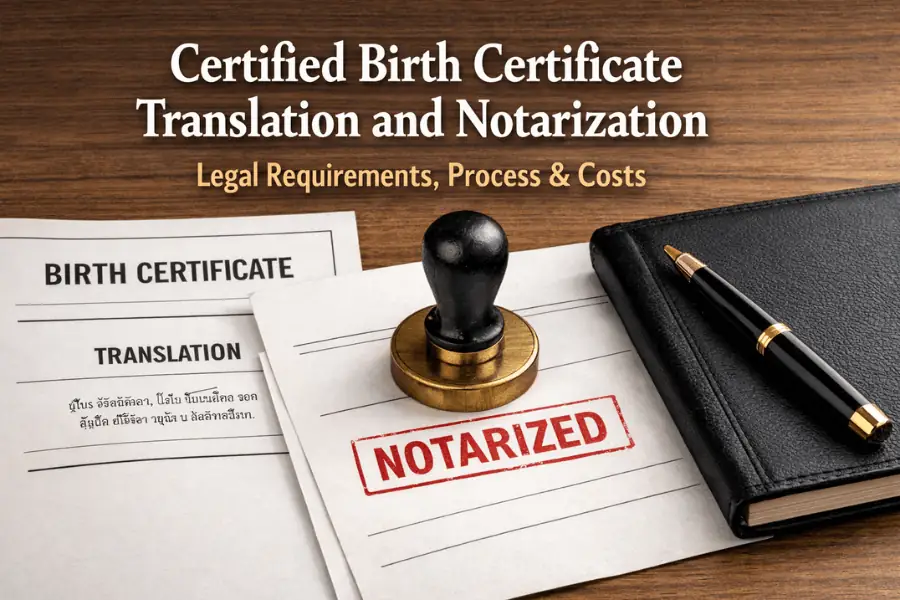
Notarized translation involves a notary public witnessing the translator’s signature on the certification statement, adding a layer of legal verification. The notary confirms the translator’s identity but does not evaluate the translation’s content, that remains the translator’s own responsibility. This step is often required for documents submitted to courts, embassies, or certain government agencies. Notarization adds an official seal and stamp confirming the authenticity of the translator’s certification for legal use.
Certified vs. Notarized Translation: Key Differences
Certified translations focus on the translator’s assurance of accuracy. Notarized translations add external validation through a notary. Here’s a simple comparison:
| Aspect | Certified Translation | Notarized Translation |
|---|---|---|
| Focus | Accuracy and completeness, certified by the translator | Translator’s identity, verified by a notary |
| Requirement | Common for immigration and academic submissions | Needed for legal, court, or international apostille processes |
| Process | Translator signs a statement | Notary witnesses and seals the signature |
| Cost | $22.99–$60 per page | Additional $10–25 for notarization |
| Usage | USCIS applications and immigration filings | Embassy validations or court evidence |
This distinction helps you select the right service based on your specific destination and use case.
Where Translated Birth Certificates Are Legally Required
Translated birth certificates are used in many official processes where authorities must verify identity, nationality, and legal status. These documents are treated as core identity records. Below are the key areas where they’re used:
Immigration applications: immigration authorities use birth certificates to verify identity, family relationships, and nationality. Certified translations are required for visa petitions, permanent residence applications, asylum claims, and family sponsorship cases. Errors or missing information often result in delays, document requests, or outright rejection.
Visa processing: embassies and consulates use translated birth certificates to verify identity details such as name spelling, date of birth, parentage, and nationality. All information must match supporting documents exactly, since certified translations are what prevent the inconsistencies that delay visa approval.
Passport applications: when applying for a passport in a country where the original birth certificate’s language isn’t accepted, a translated version confirms citizenship and identity. This applies to both first-time applications and certain renewals, especially when the underlying document was issued abroad.
University admissions: educational institutions use birth certificates to confirm student identity, age, and legal name. Translated certificates help universities match academic records with identity documents for registration, visa sponsorship, and student services.
Marriage registration: in international or cross-border marriages, authorities require translated birth certificates to verify legal age, identity, and marital eligibility, ensuring the marriage is recognized by government authorities.
Legal and court purposes: courts use translated birth certificates as official evidence in cases like custody, inheritance, adoption, citizenship disputes, and family law matters, where the translation must be precise and certified to be accepted as legal proof.
Government documentation: government agencies require translated birth certificates for access to services such as social security registration, national ID issuance, residency documentation, healthcare enrollment, and benefit programs, so that eligibility can be verified without administrative delay.
Who Is Legally Authorized to Translate a Birth Certificate?
Legally valid translations must be completed by qualified professionals or certified translation agencies. These translators must be fluent in both the source and target languages and understand official document structures and legal terminology.
Authorities require a signed certification statement confirming accuracy and completeness, which is what makes the translation legally usable in the first place. Professional accreditation from a recognized translation body adds an extra layer of trust and acceptance, showing that the translator meets the professional and ethical standards official documentation requires.
Self-translations, or translations by family members or other unqualified individuals, are rejected for lacking independent verification, regardless of how accurate the actual wording might be.
Who Is Authorized to Notarize a Translation?
Notaries public officially licensed by state or national authorities are legally authorized to notarize translations. Their role is to verify identity and witness the signing of the certification statement, not to judge the translation’s quality.
Notaries must remain impartial and cannot notarize documents where they have a personal or financial interest, which keeps the notarization process legally valid and unbiased. In some countries, embassies and consulates also provide notarization services for international documents, which is especially useful for citizens living abroad who need documents legalized for use in their home country.
Where to Get Legally Accepted Translation and Notarization
You can obtain translation and notarization services through several types of providers, depending on your timeline, budget, and legal requirements. The right choice depends on how quickly you need the documents, whether you need certification, notarization, or apostille, and which authority will receive them.
Professional translation agencies: these specialize in official document translation and work with certified linguists trained in legal and government documentation. They’re well suited for urgent requests and high-volume processing, and usually offer standardized certification statements with structured quality control.
Certified translation services online: online platforms let you upload documents remotely and receive certified translations digitally or by mail. They’re ideal for users who need fast service without visiting a physical office, and often include optional notarization and remote verification for international or time-sensitive cases.
Legal translation offices: these focus specifically on legal and official documents, ensuring terminology accuracy, formatting compliance, and legal consistency. They’re best suited for court cases, legal disputes, and complex documentation where wording precision is critical.
Immigration consultants: these often work with professional translators to streamline the application process, helping ensure documents meet immigration authority requirements from the start and reducing errors or missing certifications in the filing.
Local notary public offices: these provide notarization services after translation is already complete, a good option if you already have a certified translation and only need the notarization step. Convenient for in-person verification and same-day needs.
Embassy and consulate services: embassies and consulates sometimes offer translation and notarization for citizens living abroad who need documents legalized for use in their home country, following official government procedures commonly accepted by domestic authorities.
Law firms and legal service providers: these offer integrated services for legal cases that require certified translation, notarization, and document legalization together, best suited for complex matters like litigation, inheritance cases, or international disputes.
Online vs. Local Services: Which Is Better?
| Factor | Online Services | Local Services |
|---|---|---|
| Convenience | 24/7 access, remote upload | In-person meetings |
| Speed | 24–48 hours typical turnaround | 1–3 days |
| Cost | $22.99–$60 per page | $40–75 per page |
| Reach | Global, multilingual | Limited to local languages |
| Security | Encrypted platforms | Physical handling risk |
Online services suit fast, cost-effective needs, while local services work better for in-person verification and personalized handling. For more on choosing a reputable provider, see our guide on online birth certificate translation services.
Best Online Platforms for Birth Certificate Translation and Notarization
Top platforms in this space include Pro Translation Service, ImmiTranslate, and RushTranslate. These providers specialize in certified document translation with optional notarization for legal, immigration, and government use.
They offer structured compliance processes, including certified translations, standardized certification statements, and official notarization options, designed to meet institutional acceptance standards for submissions to immigration authorities, courts, universities, and government agencies.
Users benefit from secure document handling, predictable turnaround times, and consistent quality control, which ensures translations are not only accurate but formally acceptable for official purposes.
Step-by-Step Process to Translate and Notarize a Birth Certificate
For the full translation walkthrough, start with our guide on how to translate a birth certificate to English. The general process:
- Scan and upload the original certificate. Create a clear, high-quality scan or photo of the birth certificate. Ensure all text, stamps, seals, and handwritten notes are visible so the translator can reproduce every detail accurately.
- Select the language pair and service type. Choose the source and target languages, then select whether you need certified translation only or certified plus notarization, depending on the authority’s requirements.
- Receive the quote and approve the order. Review pricing, turnaround time, and service scope. Confirm the order once all requirements are clear, to avoid delays or revisions later.
- Translator completes the translation with certification. A qualified translator prepares a full word-for-word translation and attaches a signed certification statement confirming accuracy and language competence.
- Notary verifies the certification, if selected. A notary public verifies the translator’s identity and witnesses the signing of the certification statement, either through secure remote notarization or in person. This step only happens if notarization is part of the service you selected.
- Download or receive the final documents. You receive the certified and notarized translation digitally or by mail, ready for submission to immigration offices, courts, universities, or government agencies.
Apostille vs. Notarization: What’s the Difference?
Notarization and apostille serve two different legal functions in document authentication. Notarization is a domestic process: a notary public verifies the identity of the person signing a document and witnesses the signature. This confirms the signature is genuine but says nothing about the document’s content.
An apostille, defined under the Hague Convention, is an international certification that authenticates the origin of a public document so it’s legally recognized in another member country. Notarization establishes trust domestically; apostille extends that trust across borders by confirming the notarization or official signature itself is genuine and authorized.
Do You Need an Apostille After Notarization?
In most cases, yes, if the document is going to a country that’s a member of the Hague Convention, notarization alone isn’t sufficient for international recognition. The document must be notarized first, and then an apostille issued by the designated government authority to certify the notary’s own signature and authority. This two-step process is what lets a foreign authority accept the document without requiring further legalization.
Step-by-Step: Getting an Apostille After Notarization
One detail trips people up here: U.S. birth certificates are state-issued documents, not federal ones, so the process runs through your state, not the federal government. What actually needs the apostille, the original certificate, the notarized translation, or both, depends entirely on what the receiving country requires for that specific submission.
- Confirm what needs authenticating. Some receiving countries want the original birth certificate itself authenticated. Others want the notarized translation authenticated instead. Some want both submitted together. Check with the receiving authority before you submit anything for apostille, rather than guessing.
- If the original certificate needs authentication, submit the certified copy to your state’s Secretary of State (or equivalent vital records authority), since birth certificates are issued at the state level, not by the federal government. This is a different office than the U.S. Department of State’s own apostille service, which only handles federally-issued documents.
- If the translation itself needs authentication, the translator signs their certification statement in front of a notary first. That notarized document can then go to the same state Secretary of State’s office for its own, separate apostille, distinct from any apostille on the original certificate.
- Receive the apostille certificate, attached to whichever document you submitted.
- The apostilled document is now valid for use in any Hague Convention member country, with no further legalization required for that destination.
Exact procedures and fees vary by state, so don’t assume your state matches this example exactly. California’s Secretary of State is one illustrative example of how this works in practice; confirm your own state’s specific process before submitting anything for apostille. See our full list of countries we cover for destination-specific guidance.
Country-Specific Requirements, in Brief
Requirements differ by destination in ways that go beyond translation alone. USCIS requires certification only, no notarization unless specifically requested by the office handling your case. IRCC in Canada may require a sworn affidavit if the translator isn’t officially certified. UKVI in the UK requires a signed declaration of accuracy but not notarization for standard visa submissions. Australia requires NAATI-accredited translators. The UAE requires Ministry of Justice-approved providers plus attestation, since it isn’t a Hague Convention member and apostille isn’t available there. For the full country-by-country breakdown, see our legal requirements by country guide.
Cost of Birth Certificate Translation and Notarization
| Service | Average Cost | Factors Influencing Price |
|---|---|---|
| Translation | $22.99–$60 per page | Language rarity, urgency |
| Notarization | $10–25 | State fees, remote vs. in-person |
| Apostille | $20–50 | State requirements, expediting |
Checklist Before Submitting Translated Documents
- Confirm completeness
- Verify the certification statement
- Check the format matches the original
- Ensure the notary seal is present, if needed
- Review for errors before you submit
Frequently Asked Questions
Selecting a reliable provider ensures smooth processing and avoids unnecessary complications down the line. Prioritize certified, compliant services and verify requirements for each authority before submission. Always confirm whether certification, notarization, or apostille is required, and which document that apostille actually needs to attach to, so your documents are accepted without delay the first time.
Order Your Translation Now & Get These
Features IN THE SAME PLACE:


Reviewed by Luisa Cambilargiu - Certified Parliamentary Interpreter & Legal Translator